
Most SaaS founders think the way to raise money is to build an impressive product. In practice, the opposite is usually true: the founders who land funding are the ones who build the smallest product that proves the idea works, then walk into the room with real users, early revenue, and a clear story about what the money is for. A lean MVP is not a compromise you make because you can't afford more — it is often the single most persuasive thing you can put in front of an investor.
At Vadimages we build custom software and MVPs for small and mid-sized businesses across the Pacific Northwest, from just across the river in Vancouver, Washington. This is a case study about how a tightly scoped SaaS MVP helped an early-stage founder move from a pitch deck full of promises to a working product that investors could actually use — and how that shift is what got the round closed. If you are weighing how much to build before you raise, this is the pattern worth understanding.
A note on this case study: the story below is a composite based on typical early-stage MVP projects we take on. The founder and company are representative rather than a single named client, and the figures are illustrative of the outcomes we commonly help create, not a guaranteed result or a specific investment record. When we have a named client story cleared for publication, we link it from our case studies page.
The situation: a strong idea and a hard deadline
The founder came to us with a familiar shape of problem. She had spent a decade inside a specialized service industry and had watched the same operational headache repeat at every company she worked for. She was convinced software could fix it, she had talked to dozens of potential customers who agreed, and she had lined up conversations with a small group of angel investors and one early-stage fund. What she did not have was anything an investor could touch. Her "product" was a deck, a spreadsheet model, and a set of design mockups.
That is a fragile place to pitch from. Investors have seen thousands of decks. A slide that says "users will love this" carries almost no weight, because everyone's slides say that. She had a real window — a warm introduction and genuine interest — but she needed to convert interest into conviction, and she had roughly three months before those conversations went cold. The question she brought to us was blunt: what is the least we can build that turns this idea into something an investor believes?
The challenge: proof, not polish
When we mapped out what she actually needed, it became clear the goal was not "a product." The goal was evidence. An MVP built to raise money has a slightly different job than one built purely to test a market, and it helps to be honest about that up front. It needs to do three things at once:
- Prove the core idea works in software. Not the whole vision — the one workflow that is the reason the company should exist. If that single thing is genuinely useful, the rest is a roadmap. If it isn't, no amount of features will save it.
- Produce real signal. Actual people using the product, ideally paying something, generating the kind of usage data and testimonials that a deck cannot fake. This is what turns "I think" into "here is what happened."
- Be demonstrable and credible under scrutiny. An investor or a technical advisor they trust will click around. The happy path has to work cleanly, and the thing has to look like a real product, not a rough prototype held together with tape.
The trap most first-time founders fall into is trying to build the impressive version — the full platform from the pitch deck — because they assume investors fund ambition. They don't fund ambition; they fund de-risked ambition. Every extra feature we might have built was a week not spent getting real users onto the core workflow, and real users were the entire point. So the hard part of this project was mostly subtraction: deciding, together, what not to build.
How we approached it
We did not start with code. We started by getting ruthless about scope, because on a three-month clock scope is the only lever that matters. Our process on an MVP like this is deliberately front-loaded with hard conversations, so the build itself can be fast and calm.
- Find the one workflow. We pushed the founder to name, in a single sentence, the core job her product does. Everything on the screen would have to serve that sentence or get cut. For her, it was one specific sequence: take a messy real-world input, run it through the logic she understood better than anyone, and hand the user back a decision they could act on immediately.
- Draw the line between "MVP" and "someday." We built a parking lot — a simple list of every feature from the deck that would not ship in version one, with a note on why. Team accounts, an analytics dashboard, integrations, admin configurability: all real, all deferred. Nothing was thrown away; it was sequenced.
- Design for a paying pilot, not a launch. We scoped the MVP to support a small group of early users who would pay a modest amount to use it for real. Paid, even a little, because a paying user is the strongest signal there is — free users are polite, paying users are honest.
- Ship in slices. We put working pieces in front of the founder every couple of weeks so the design could react to reality instead of assumptions. That rhythm also meant she always had something recent to show, which mattered as investor conversations started before the product was "finished."
This is the same philosophy behind our tagline: we build for humans and optimize for growth. An MVP that ignores how its first users actually work gets abandoned no matter how clever the underlying idea is — and an abandoned MVP proves nothing to anyone.
What we built
The result was a focused SaaS application that did one thing genuinely well. It was not thin — the core workflow was polished, fast, and trustworthy — but it was narrow. The pieces were exactly the four an MVP needs and nothing more:
- Simple authentication. Email-and-password sign-up and login. No team invites, no roles, no single sign-on. One user, one account.
- The one core workflow, done deeply. The full sequence from messy input to actionable output, built to feel effortless. This is where nearly all of the engineering effort went, and it showed.
- Real billing. A payment processor wired up with one simple plan, so pilot users could actually subscribe and be charged. This turned "would people pay?" from a hypothesis into a line on a chart.
- A bare-bones admin view. A protected internal page so the founder could see who signed up, look at their activity, and support them by hand. Enough to run the pilot, nothing more.
Under the hood it was an ordinary, maintainable web application: a proper database, a clean interface built for the people using it, and secure managed hosting. Nothing exotic, and deliberately so. We did not build microservices or multi-region infrastructure for a product with a handful of users, because that work solves problems you do not have yet and burns the runway you need for the problems you do. A single well-structured application was exactly right, and it kept the codebase small enough to change quickly when the pilot taught us something.
Turning the product into proof
The MVP was the tool; the evidence was the deliverable. Over the weeks the pilot ran, a story assembled itself that no pitch deck could have manufactured. A group of early users signed up and, more importantly, kept coming back — they used the core workflow repeatedly because it saved them real time. A meaningful share converted to the paid plan. The founder collected specific, quotable feedback from named users describing the before-and-after in their own words. And because the product logged real usage, she could show retention and engagement curves instead of describing them.
That changed the entire character of her investor conversations. Instead of "here is what I believe will happen," she could say "here is what happened when real people paid to use this." She could hand an investor a login and let them run the core workflow themselves. When a fund brought in a technical advisor to kick the tires, the happy path held up because we had built it to. The pitch stopped being a promise and became a demonstration — and demonstrations are what move money.
The results
Within the pilot window, the representative outcomes looked like this:
- A working, paid product in roughly ten weeks — well inside the three-month funding window, with time to spare for iteration based on early feedback.
- A small cohort of paying pilot users generating real subscription revenue, modest in dollars but enormous in signal, plus retention data that showed people came back.
- Concrete testimonials from named early customers, which the founder used directly in her pitch and follow-up materials.
- A closed early-stage round. The founder secured the funding she was after, and the investors' own feedback pointed at the same thing: the working product and the paying users were what made the difference between a maybe and a yes.
The less measurable win mattered just as much. She walked into every subsequent meeting with the quiet confidence of someone showing rather than selling. These figures are illustrative of the kinds of outcomes we help early-stage founders create; your results depend on your idea, your market, and the investors you are talking to. Building an MVP is never a guarantee of funding — but it is the strongest position from which to ask.
What actually made this MVP fundable
Stepping back from the specifics, a few principles did the heavy lifting, and they generalize to almost any software a founder might raise on.
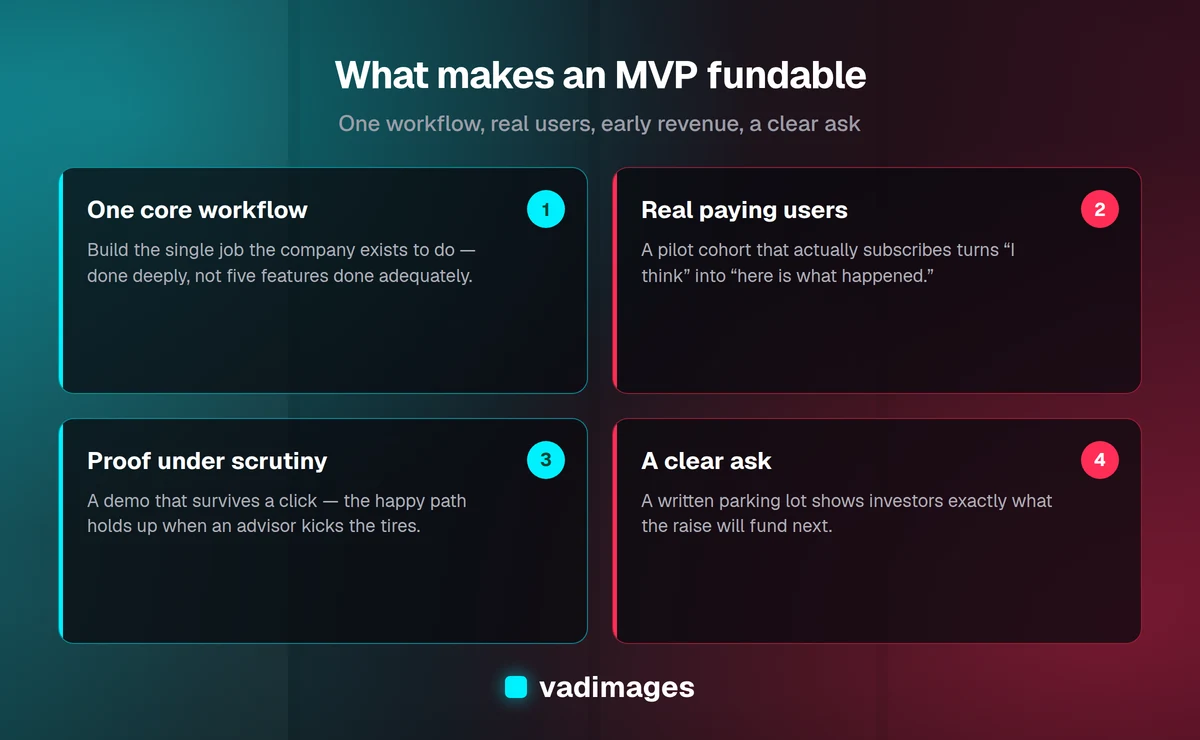
- Narrow beats impressive. One core workflow done excellently is more convincing than five features done adequately. Investors are trying to assess whether the central bet is real; give them a clean look at exactly that.
- Paying users are the proof. Revenue — even tiny revenue — is the difference between a story and a fact. Build billing into the MVP so you can collect that fact early.
- Speed protects the window. Funding interest is perishable. A scope you can ship in weeks keeps you in the conversation; a scope that takes a year lets the moment pass.
- The demo has to survive a click. Investors and their advisors will use the thing. The happy path being genuinely solid buys more credibility than any slide.
- A clear "what the money is for." Because the parking lot was written down, the founder could point at exactly what the raise would fund next. A credible roadmap grounded in a working product reads very differently than a wish list.
Frequently asked questions
Do I really need a working product to raise, or is a deck enough? Some founders raise on reputation and a deck alone, but they are the exception, usually with a strong track record. For a first-time founder, a working MVP with real users is the most reliable way to turn interest into commitment. It removes the biggest question in an investor's mind — "can this actually be built and will anyone use it?" — by answering it out loud.
How much should an MVP like this cost? Vadimages projects start at $5,000 and up, scoped transparently to what you need. For a funding-focused MVP we deliberately size the first release around the single core workflow so you spend on proof, not on features you would only defer anyway. You can see how we think about this on our pricing page.
How long does it take? A tightly scoped SaaS MVP often lands in roughly one to three months. If an estimate is stretching past that, it is usually a sign the scope has crept beyond a true MVP and some "must-haves" are actually deferrable.
What if I don't raise after building it? Then you still own a working, revenue-generating product and a clear picture of what your first users value — which is a far better position than an unbuilt idea. A good MVP is useful whether or not the round closes, because the point was always to learn and to earn, not only to pitch.
Will the MVP scale if we grow fast after funding? A well-built MVP is designed to be extended, not thrown away. We keep the codebase clean and the architecture simple so that when funding arrives and the roadmap opens up, the parking-lot features can be built on top of a solid foundation rather than requiring a rewrite.
The bottom line
The founders who raise are rarely the ones who built the most. They are the ones who built the right small thing, put it in front of real users, and walked into the room with proof. A focused SaaS MVP — one core workflow done well, real people paying to use it, and a clear plan for what comes next — is not a lesser version of your product. For the purpose of a raise, it is the most powerful version you can have.
If you are an early-stage founder trying to decide how much to build before you raise, we would be glad to help you find the smallest version of your product that can start earning and proving. Start a conversation at https://vadimages.com/contact and let's scope an MVP built to get you to a yes.