

On April 29, 2026, Stripe used its annual Sessions conference to announce 288 new products and features in front of more than 9,000 business leaders — and the through-line was impossible to miss. Stripe is rebuilding its payments stack around AI agents: software that discovers products, fills carts, and pays on a customer’s behalf. Six weeks later, those capabilities are rolling out to dashboards, and businesses that process payments — fintech products, SaaS platforms, and online sellers alike — are facing a practical question: what does it mean when your next customer isn’t a person clicking “Buy,” but an agent calling an API?
AI agents can now buy from you — through Meta, Google, and an open protocol
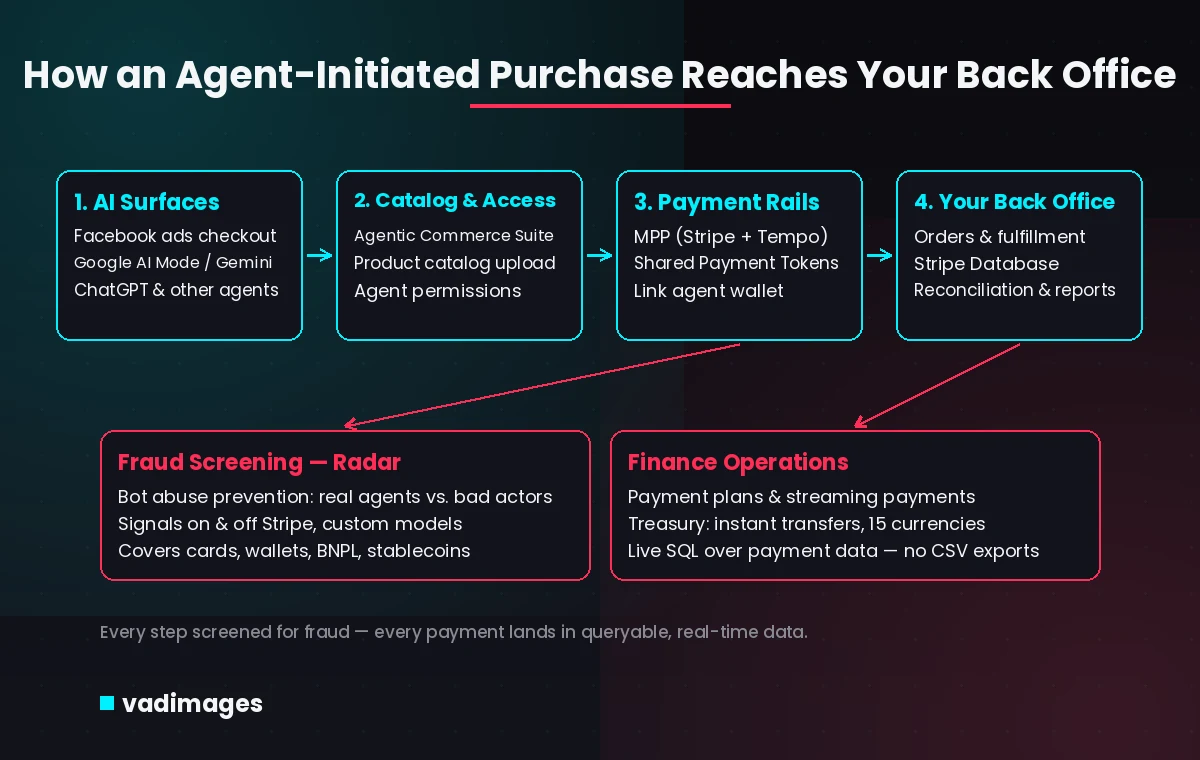
The centerpiece is Stripe’s expanded Agentic Commerce Suite. Businesses can now upload a product catalog and manage which AI agents are allowed to sell their products directly from the Stripe Dashboard. Two partnerships give that capability immediate distribution: Stripe and Meta are enabling native checkout inside Facebook ads, so discovery and purchase happen in a single flow, and a new partnership with Google means customers will soon be able to buy products inside AI Mode and the Gemini app via the Universal Commerce Protocol (UCP).
Under the hood sits the Machine Payments Protocol (MPP), co-authored by Stripe and Tempo, which lets agents transact programmatically — including microtransactions and recurring payments. Businesses can accept agent-initiated payments in stablecoins as well as fiat through cards, Klarna, and Affirm using Shared Payment Tokens via the existing PaymentIntents API. On the consumer side, Stripe’s Link wallet gained an agent mode: customers can authorize an agent to pay on their behalf while keeping spending approvals and full purchase visibility.
Fraud tooling had to change with it
If agents can pay, fraud systems must tell a legitimate shopping agent apart from a credential-stuffing bot — and Stripe called this its biggest-ever set of Radar upgrades. The highlights for payment-heavy businesses:
- Bot abuse prevention (in preview) is designed to distinguish legitimate AI agents from fraudulent automated actors, instead of blocking automation wholesale.
- Free trial abuse prevention identifies high-risk trial signups without turning away real customers.
- Stripe Signals exposes payment, customer, and merchant risk signals so you can identify fraudulent payments both on and off Stripe.
- Custom Radar models can now be trained on your own business signals combined with Stripe’s network intelligence.
- Radar protection now extends to bank debits, wallets, buy now, pay later options, and stablecoins — not just cards.
Acceptance economics improved too: Authorization Boost’s new AI-powered optimizations, including Data Only 3DS authentication flows, are increasing acceptance rates by an average of 3.8% while lowering processing costs by up to 3.3%, according to Stripe’s figures.
The back office: real-time money movement and queryable data
The announcements that may matter most to finance teams got the least stage time. Stripe previewed payment plans — installment billing with automated collection — and streaming payments built on Metronome and Tempo, where a business gets paid the instant value is delivered rather than at end-of-cycle invoicing. Stripe Treasury added free instant transfers between US businesses on Stripe, a corporate card with 2% cashback on settled earnings, multi-currency storage in 15 currencies by year-end, and agent-ready financial accounts that let an AI agent check balances, pay invoices, and manage cash flow with human-in-the-loop confirmation on key actions.
For reconciliation and reporting, the standout is Stripe Database: a managed, hosted, read-only Postgres database of your live Stripe data, spun up in one click. Together with the next generation of Data Pipeline (real-time syncs, starting with Google Sheets) and a Reports API for running Sigma SQL queries programmatically, it removes a whole category of brittle CSV-export-and-import work that finance operations teams have lived with for years.
Why this matters for payment-driven businesses now
It is tempting to file agentic commerce under “wait and see.” The reason not to: the distribution side is already moving. When checkout happens inside Facebook ads, Gemini, or ChatGPT, the businesses that win those sales are the ones whose catalogs, pricing, and inventory are exposed in a structured, machine-readable way — and whose payment stack can accept a Shared Payment Token without a human in the loop. Businesses with messy product data or hand-stitched checkout flows simply will not appear in agent-mediated purchases.
There is an operational cost to ignoring it, too. Every new flow — installments, streaming payouts, stablecoin settlement, agent wallets — is a new edge case in your ledger. Finance teams that still reconcile from exported reports will feel the lag first; teams that query live payment data directly will close faster and dispute smarter, using evidence libraries and AI-recommended dispute fields that Stripe now compiles automatically.
How Vadimages helps
Vadimages builds custom software for fintech and financial services companies, and payment infrastructure is where we spend much of our time. We design and integrate Stripe payment flows end to end — Checkout, PaymentIntents, Billing, and Connect — and build the transaction processing pipelines behind them. For teams drowning in manual back-office work, we build automated reconciliation services that match ledger entries against live Stripe data, and custom reporting dashboards that give finance leaders real-time visibility instead of week-old exports. And for businesses that want to be ready for agent-mediated sales, we audit and restructure product catalogs, APIs, and checkout flows so agents can find you, price you, and pay you — with fraud rules tuned for the new traffic.
Bottom line
Stripe Sessions 2026 was the moment agentic commerce stopped being a demo and became shipping infrastructure, with Meta and Google distribution attached. The capabilities are arriving in dashboards now. Whether you run a fintech product or sell online, the work is the same: structured catalogs, API-first payment flows, agent-aware fraud rules, and reconciliation that reads live data. Start with an audit of how an AI agent would see your business today — the answer is often “it can’t.”