
If your business ships anything in the US — ecommerce parcels, spare parts, service kits, freight paperwork — there is a good chance an address form somewhere in your stack quietly talks to USPS. And USPS is in the middle of the biggest overhaul of its developer platform in two decades. The legacy Web Tools API platform was switched off on January 25, 2026. An API Access Control security layer arrived in April. And on July 12, 2026, USPS launches its Enhanced Addresses API, promising near real-time address updates, improved matching logic, and additional address indicators. If your team patched things together during the January shutdown and moved on, this July change is the one that can catch you off guard: the endpoint your checkout or dispatch board calls is about to start behaving differently, whether you are ready or not.
What actually changes on July 12
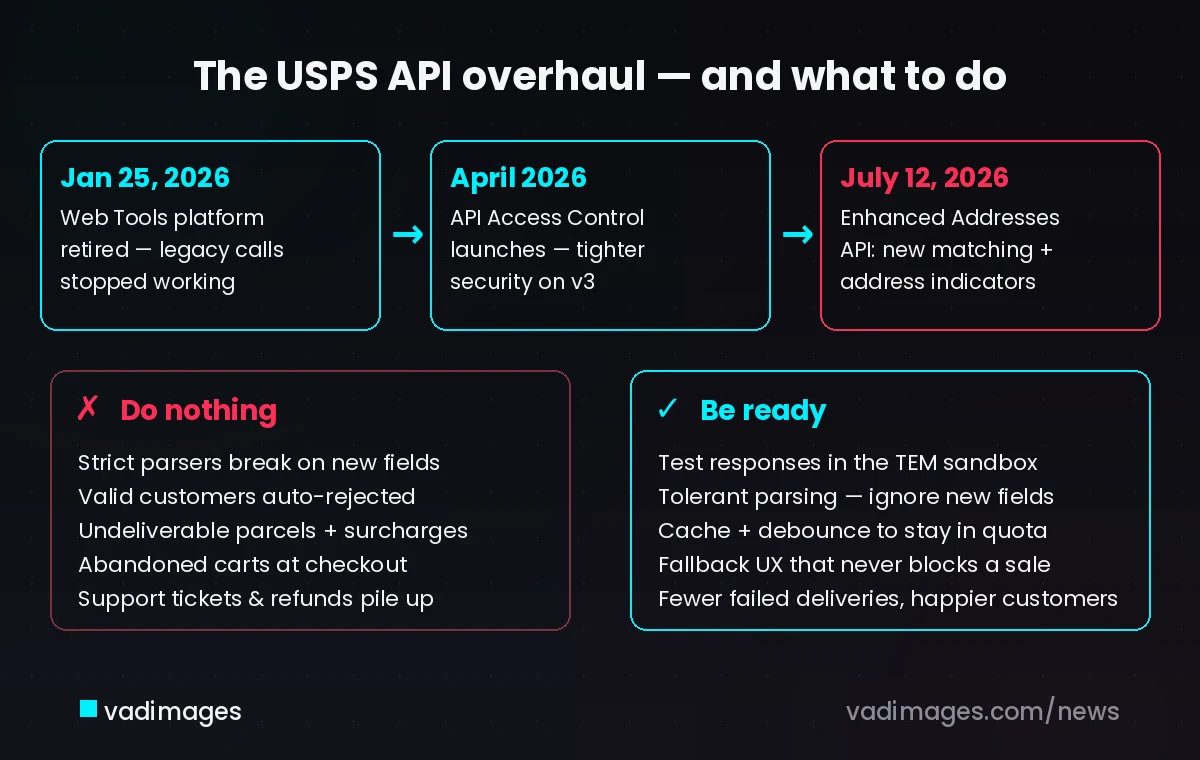
Two things land on the same day. First, USPS enhances the Addresses API on its modern OAuth 2.0 platform at developers.usps.com. According to the PostalPro industry alert published April 13, 2026, the upgraded API adds near real-time address updates, improved matching logic, and additional address indicators — more metadata about whether an address is deliverable, vacant, or needs a secondary unit. Second, the Postal Service publishes a Domestic Mail Manual revision (Postal Bulletin 22699) that formally replaces every reference to the retired Web Tools platform with the new USPS API platform. In plain terms: the old world is now officially gone from the rulebook, and the new Addresses API becomes the single source of truth for address quality.
For a logistics operation this is not a cosmetic update. Address validation sits at the front of everything downstream — rating, labeling, routing, delivery promises. When the matching logic changes, the answers change. An address that validated cleanly in June may come back in July with a correction, a new indicator flag, or a different standardized form. Software that treats any unexpected response as a failure will start rejecting real customers.
What happens if you do nothing
If any of your code still points at the old Web Tools endpoints, it has been broken since January 25 — check now, because batch jobs and rarely used admin tools are where dead integrations hide. If you are already on the v3 REST APIs, the risk is subtler: brittle response parsing. Strict parsers that fail on unknown fields can choke when the additional address indicators appear. Validation logic that auto-rejects anything other than an exact match can start blocking legitimate orders when the improved matching returns corrections instead of confirmations.
The business cost is concrete. Bad addresses become undeliverable-as-addressed shipments, address-correction surcharges, and redelivery fees. Every failed delivery generates a “where is my order” support ticket and, often, a refund. And if your checkout hard-blocks on a validation error, you do not get a bad address — you get an abandoned cart.
What you gain by acting — and what your customers feel
Handled well, this upgrade is a gift. Near real-time address data means new construction, new rural routes, and fresh apartment conversions are recognized sooner — fewer good addresses falsely rejected. Improved matching means typos get corrected at checkout instead of on a returned parcel. The extra indicators let you prompt for a missing unit number before the order ships rather than after it bounces. Your customer sees a checkout that quietly fixes their address, a package that arrives the first time, and no awkward refund email. Your dispatchers see a board they can trust.
What to do on your own site or app this week
Start with an inventory: find every place an address enters or leaves your systems — checkout, account pages, quote and booking forms, driver and dispatch tools, batch imports, CRM syncs. Confirm each one authenticates with OAuth 2.0 against the v3 platform and that no code or config still references Web Tools hosts. Then test against the USPS TEM sandbox (the same endpoints with –tem in the host name) so you see the enhanced responses before production does. Make your parsers tolerant: ignore fields you do not recognize, and treat new indicators as useful data, not errors. Finally, respect the platform’s quota limits — USPS returns 429 errors when you exceed your hourly allowance — by caching validated addresses, debouncing autocomplete lookups, and queuing batch work.
Your quick-win checklist
- Search your codebase and server configs for any remaining Web Tools URLs (secure.shippingapis.com, production.shippingapis.com) — anything found is already dead code.
- List every address entry point: checkout, signup, quotes, dispatch, imports, CRM. Each one is a place July 12 can surprise you.
- Run a fixed set of known-good and known-bad addresses through the TEM sandbox now, and again after July 12 — diff the responses.
- Loosen response parsing so unknown fields and new indicators never throw errors.
- Cache validated addresses for repeat customers so you stay under quota and keep checkout fast.
- Add a graceful fallback: if validation is unavailable, accept the order, flag it for review, and never hard-block a paying customer.
- Set an alert on spikes in 4xx/5xx responses from your address endpoint — that is your early-warning system.
- Log every validation correction for two weeks after launch; the pattern tells you if your forms need a unit-number prompt.
How Vadimages helps
Vadimages builds the web and mobile software that sits on top of carrier APIs — and keeps working when the carriers change them. For logistics and ecommerce teams we audit existing USPS, FedEx, and UPS integrations and migrate any remaining legacy code to the modern REST platforms. We build a carrier-agnostic integration layer, so your checkout, booking flow, and dispatch dashboard call one stable internal service — when USPS changes its matching logic again, we update one adapter, not five applications. We design address-entry UX that uses the new indicators well: autocomplete, inline corrections, unit-number prompts, and a fallback path that never blocks a sale. And we ship the operational dashboards — validation failure trends, undeliverable rates, quota usage — so your team sees problems before your customers do. The July 12 change becomes a line item we handle, not a fire you fight.
Bottom line
USPS finishes its platform overhaul on July 12, 2026, when the Enhanced Addresses API goes live and the mailing rulebook formally moves on from Web Tools. Businesses that verify their integrations, test in the sandbox, and loosen brittle parsing this week will get better address data and fewer failed deliveries. Businesses that do nothing will find out at checkout. A one-day audit now is cheaper than a week of undeliverable parcels later.