

Fixed price vs time and materials is the choice between paying one agreed price for an agreed scope of software, or paying for the hours a team actually spends. A fixed-price contract puts the risk of the estimate on the vendor and works best when the scope can be written down clearly before the build starts. A time-and-materials (T&M) contract puts that risk on you, the buyer, and works best when the scope is still being discovered. For most US small and mid-sized businesses, the safest answer is neither in its pure form: pay a fixed price for a short discovery phase, then fix the price of each build milestone once that milestone is clearly defined.
This guide is written by Vadimages, a custom software studio in Vancouver, WA, for owners and operations leads who are about to sign their first or second software contract. We explain how each model works, where each one goes wrong, what questions to ask before you sign, and how we structure our own engagements. Where we describe our own approach, we say so; the rest applies whichever vendor you hire.
What a fixed-price software contract is
A fixed-price software contract is an agreement to deliver a defined scope for a defined price, usually paid in installments tied to milestones. The vendor estimates the work, adds a margin for uncertainty, and commits to the number. If the work takes longer than estimated, the vendor absorbs the cost. If you want something that was not in the agreed scope, you go through a change order, which is a written amendment with its own price and timeline.
The appeal is obvious: you know the number before you start, you can take it to your partners or your bank, and you are not paying for a slow week. The catch is that a fixed price is only as good as the scope document behind it. A vague scope produces either a padded price, because the vendor is pricing the unknowns, or a stream of change orders, because every unclear line becomes an argument about what was included.
When fixed price works well
- The workflow is known. You can describe who uses the system, what they do step by step, and what the output is.
- The integrations are known. You can name the systems involved (QuickBooks Online, Shopify, HubSpot or Salesforce, UPS or FedEx shipping APIs) and the vendor has checked their APIs.
- Acceptance criteria can be written. For each feature, both sides can agree in advance on what "done" looks like.
- You need budget certainty. A fixed number for a board, a lender, or a grant matters more to you than flexibility.
What a time-and-materials contract is
A time-and-materials software contract is an agreement to pay for the hours the team works, at agreed rates, plus any direct costs such as hosting or third-party licenses. There is usually an estimate, but the estimate is not a promise. You get a timesheet or an invoice each period, and the final cost is whatever the work took.
T&M gives you flexibility: you can change priorities every week without negotiating change orders, and you are not paying the uncertainty margin a vendor builds into a fixed price. The cost of that flexibility is that the budget risk sits with you. If the work is harder than expected, if decisions take longer on your side, or if the team is simply slow, the invoice grows. Without a cap, regular demos and someone on your side who reads the timesheets, T&M can quietly turn a $40,000 project into a much larger one.
When time and materials works well
- The scope is genuinely unknown. You are testing a new product idea and expect to change direction based on what users do.
- The work is ongoing. Maintenance, small improvements and support do not have a natural end date.
- You have someone to manage it. A product owner on your side who sets priorities, attends demos and reviews hours every week.
- You trust the team already. T&M works best after a first project has shown you how the vendor estimates and delivers.
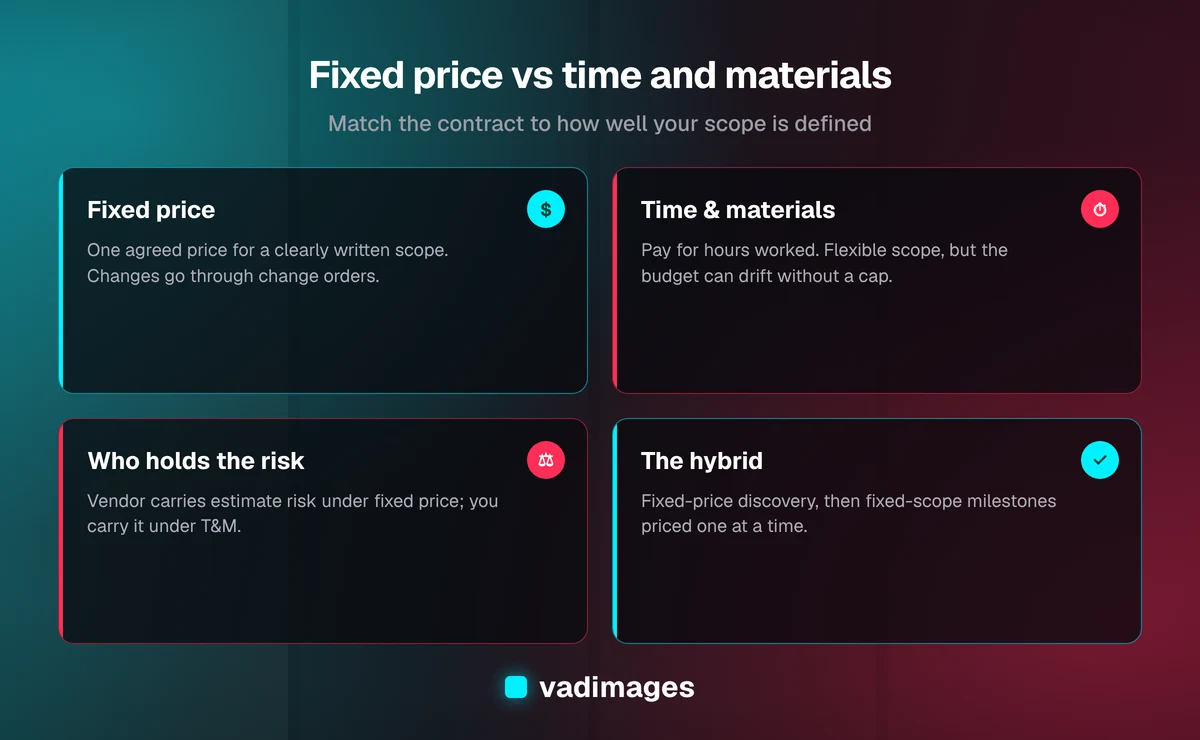
Fixed price vs time and materials: the side-by-side comparison
The real difference between fixed price and time and materials is who carries the risk that the estimate is wrong: the vendor under fixed price, the buyer under T&M.
- Budget certainty: fixed price gives you one number; T&M gives you an estimate and a running total.
- Who carries estimate risk: the vendor under fixed price; you under T&M.
- Flexibility to change scope: limited under fixed price (changes go through change orders); high under T&M (you reprioritize as you go).
- Up-front effort: fixed price needs a detailed scope before work starts; T&M can start sooner with less written down.
- What you manage: under fixed price you manage scope and acceptance; under T&M you manage hours, priorities and pace.
- Typical failure: fixed price fails through scope disputes and padded quotes; T&M fails through budget drift nobody noticed until the invoice.
Neither model is cheaper by default. A fixed price includes a margin for the vendor's risk, so on a project that goes smoothly you may pay more than the hours would have cost. On a project that goes badly, the fixed price protects you and T&M does not. You are effectively choosing whether to buy insurance against the estimate being wrong.
Where each model goes wrong in practice
Both models fail in predictable ways, and almost all of those failures trace back to the same root cause: nobody wrote down clearly enough what was being built before money changed hands.
Common fixed-price problems
- The scope was a wish list, not a specification. "A customer portal" can mean a login page with invoices, or a full self-service system with payments, messaging and document uploads. Both sides sign believing different things.
- The vendor under-bid to win. A price far below other quotes often means the vendor will make it back through change orders or cut corners on testing.
- Change orders become a negotiation. Every small adjustment turns into a meeting about whether it was "in scope", which slows the project and sours the relationship.
- Quality is the hidden variable. When time runs short on a fixed budget, the easiest thing to cut is the testing and documentation you cannot see.
Common time-and-materials problems
- No cap and no checkpoint. Hours accumulate without anyone comparing progress to the original estimate.
- Nothing visible to review. If you only see invoices and not working software, you cannot tell whether the hours are well spent.
- Scope creep feels free. Because changes do not need a change order, it is easy to keep adding "one more thing" until the original goal is buried.
- Your own delays cost you. If decisions on your side take two weeks, the team may still be billing for that time.
The hybrid most small businesses should use
For a first custom software project, the most reliable structure is a fixed-price discovery phase followed by fixed-scope, fixed-price build milestones. It keeps the budget certainty of a fixed price without asking anyone to price work that has not been defined yet.
- Fixed-price discovery. A short, separately priced phase where the vendor maps your workflows with the people who do them, checks the integrations, and produces a written scope, a milestone plan and an estimate range. You own the output and can take it to another vendor if you want.
- Fixed-scope milestones. The build is split into milestones of a few weeks each. Each milestone has its own deliverables, acceptance criteria and price, agreed before it starts.
- Demos against acceptance criteria. Each milestone ends with working software you can click through, checked against what was agreed. Payment follows acceptance.
- Re-plan between milestones. What you learned in milestone one can change milestone two, and that change is priced before it starts, not argued about afterwards.
- Retainer after launch. Once the system is live, ongoing improvements and support move to a monthly plan, which is where a flexible model makes the most sense. As of 2026, Vadimages maintenance plans run $500 to $2,000 per month.
Vadimages uses this hybrid of fixed-price discovery and fixed-price milestones on its own projects. We do not bill by the hour. As of 2026, our discovery phase is fixed-price by scope and most discovery engagements run $1,500 to $15,000. Build work is priced per milestone from the discovery plan, and ongoing product work runs as a partner or retainer engagement. You can see how the phases fit together on our how we work page.
What it costs under each model
The contract model changes how you pay, not how much the underlying work is. A well-scoped internal tool costs roughly the same amount of engineering whether you buy it at a fixed price or by the hour; the difference is who absorbs the surprises. As of 2026, Vadimages' typical ranges are $15,000 to $60,000 for a system integration, $30,000 to $75,000 for an internal tool, $25,000 to $100,000 for workflow automation, and $50,000 to $150,000 for a custom business system or SaaS MVP. Website projects start at $4,000. The full breakdown, including what moves a project up or down a range, is on our pricing page.
If one quote is dramatically lower than others for the same scope, ask what is excluded. The usual answers are testing, data migration, deployment, documentation, or the integration that everyone assumed was "simple".
Questions to ask before you sign either contract
Before signing a fixed-price or time-and-materials software contract, ask the vendor these seven questions:
- What exactly is in scope, and what is explicitly out? A good proposal lists exclusions, not just inclusions.
- How is "done" defined for each milestone? Ask to see the acceptance criteria in writing.
- How are changes priced and approved? Ask for an example change order and how long approval usually takes.
- How often will I see working software? Weekly or bi-weekly demos are a reasonable expectation for a build.
- For T&M: is there a cap, and what happens when we approach it? You want a written alert well before the cap, not after.
- Who owns the code and the accounts? The repository, hosting and domain should be in your name or transferred to you.
- What happens after launch? Ask how bugs found after launch are handled and what support costs.
How to choose: a short decision guide
Choose the contract model by how clearly you can define the scope today:
- Choose fixed price when you can write a clear scope today, the integrations are known, and budget certainty matters more than flexibility. Example: replacing a spreadsheet-based order process with a defined web app.
- Choose time and materials when the work is ongoing or exploratory, you have a product owner to manage it, and you already trust the team. Example: monthly improvements to a system that is already live.
- Choose the hybrid when you know the problem but not yet the exact solution, which describes most first custom software projects at small businesses.
If you want to see what these engagements look like end to end, our case studies walk through real scopes, and our solutions and industries pages show the kinds of systems we price this way.
Frequently asked questions
Is fixed price or time and materials cheaper for software?
Neither is cheaper by default. A fixed price includes a margin for the vendor's risk, so on a smooth project it may cost more than the hours would have. On a project with surprises, the fixed price protects you and time and materials does not. The cheaper option is usually the one that matches how well your scope is defined.
Can a fixed-price software project still change during the build?
Yes. Changes go through a change order, a written amendment that states the new work, its price and its effect on the timeline. Splitting the build into milestones keeps change orders small, because most changes can be folded into the next milestone's scope before it is priced.
What is a not-to-exceed time-and-materials contract?
A not-to-exceed contract is time and materials with a cap. You pay for hours worked, but the total cannot pass an agreed limit without your written approval. It reduces budget risk compared with open-ended T&M, but you still need regular demos to know whether the hours are producing working software.
Does Vadimages charge by the hour?
No. Vadimages prices work by scope and outcome. As of 2026, discovery is a fixed-price engagement, typically $1,500 to $15,000, the build is priced per fixed-scope milestone, and ongoing product work runs on a partner or retainer plan.
How long does discovery take before a fixed price can be quoted?
For most small and mid-sized business projects, Vadimages' discovery runs one to three weeks. It ends with a written scope, a milestone plan, a risk list and an estimate range, which is enough to price each build milestone with confidence.
Get a contract that fits your project
If you are weighing quotes or deciding how to structure a software project, tell us what you are trying to build. We will tell you honestly which contract model fits, what a realistic range looks like, and whether a fixed-price discovery phase makes sense first. Contact Vadimages to start the conversation.


