
Portland SaaS startups are software-as-a-service companies founded in the Portland-Vancouver metro that sell subscription software, usually to other businesses. Getting one started comes down to five things: a narrow problem you understand better than anyone, a handful of paying design partners, a small MVP that solves that one problem well, billing that works from day one, and a budget that matches the scope. As of 2026, a custom SaaS MVP built by an outside team typically costs $50,000 to $150,000 and takes 10 to 16 weeks. This guide walks through each step in plain English, from our office in Vancouver, WA.
It is written for founders who know their industry but are not engineers: the operations lead who has watched the same spreadsheet problem in five companies, the consultant who keeps building the same tool for each client, or the small business owner whose internal software could be sold to competitors. If that sounds like you, read on.
What makes a Portland-area SaaS startup different
Software is software wherever it is built, but the local setting shapes a few practical decisions. The metro is one economy split by the Columbia River, and founders on both sides share customers, talent, and coffee shops.
- A strong base of vertical industries. The region has deep roots in manufacturing, logistics, construction, outdoor and athletic apparel, food and beverage, healthcare, and professional services. Vertical SaaS, software built for one industry, is a natural fit, because founders often come straight out of those businesses.
- Two states, two tax setups. Oregon has no general sales tax; Washington has no state personal income tax but does have a business and occupation (B&O) tax on gross receipts. Where you incorporate, where you operate, and where your customers are all affect how you charge for software. Talk to a CPA who handles both states before you set prices.
- A practical, bootstrapped culture. Many local founders build with their own money or early revenue rather than large venture rounds. That is a strength: it forces you to find paying customers early and keep the first version small.
- Pacific time zone. Your build team, your early customers, and your support hours line up when everyone is in the same time zone. That matters more than it sounds during launch weeks.
None of this changes the fundamentals. It just means you should plan for local tax rules, lean into the industries around you, and keep the first version honest about its size.
Pick a problem narrow enough to win
The most common reason early SaaS products stall is not bad code. It is a problem that is too broad. "Project management for small businesses" competes with dozens of mature tools. "Job scheduling and permit tracking for Pacific Northwest roofing contractors" does not.
A good starting problem has four traits:
- It is painful and frequent. People deal with it every week, not once a year.
- It is currently solved badly. Spreadsheets, email threads, paper forms, or a generic tool bent out of shape.
- The buyer has a budget. Someone can approve a monthly subscription without a committee.
- You can reach the buyers. You know where they meet, what they read, and who they trust.
If you can name ten companies with this problem and get five of them on the phone, you have a starting point. If you cannot, keep narrowing.
Validate with design partners before you build
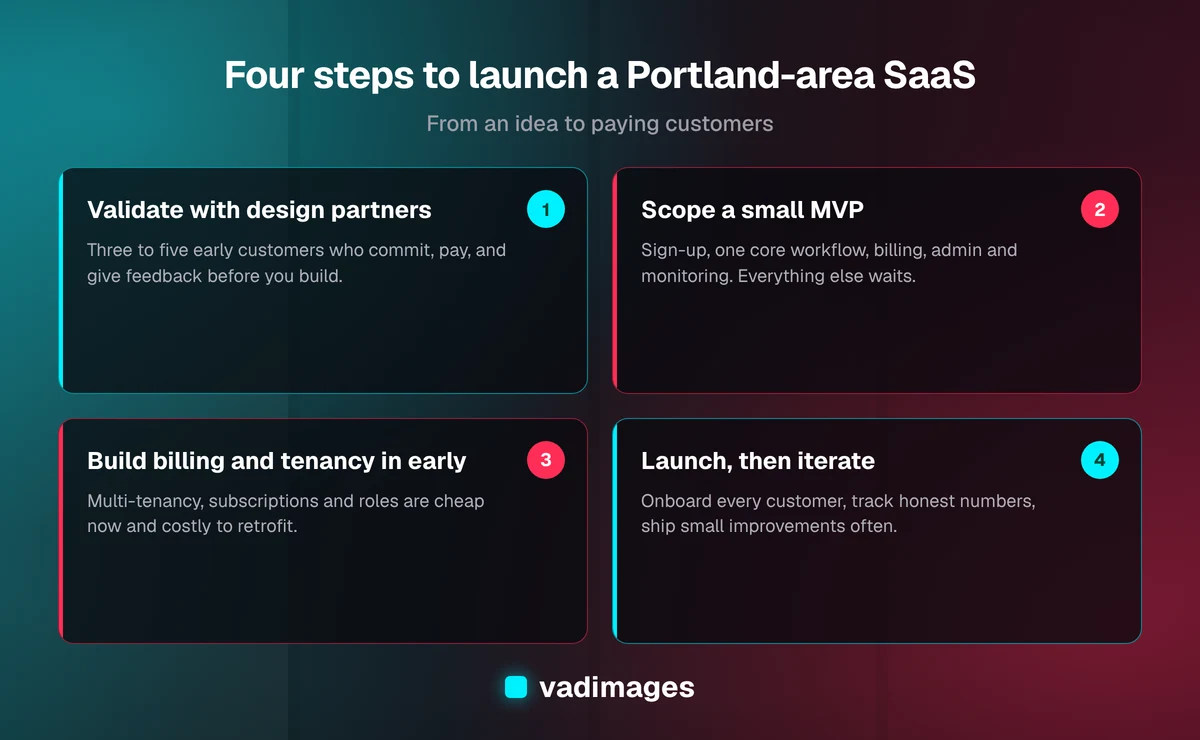
A design partner is an early customer who agrees to use your product while it is rough, give regular feedback, and usually pay a discounted rate in exchange. Three to five design partners are worth more than any market report, because they tell you what people will actually pay for.
- Interview first. Ask how they handle the problem today, what it costs them in time or money, and what they have already tried. Do not pitch yet.
- Show a clickable prototype. A few screens in a design tool are enough to see whether you understood the workflow.
- Ask for a commitment. A letter of intent, a paid pilot, or a prepaid annual plan at a founder's discount. Commitments separate polite interest from real demand.
- Write down what they will not compromise on. Those items become the core of your MVP. Everything else waits.
This step costs very little and saves the most money. Founders who skip it often build features nobody asked for and run out of budget before they find the one feature that sells.
Scope an MVP that does one job well
A minimum viable product (MVP) is the smallest version of your software that a paying customer would use to solve the core problem. For most B2B SaaS products, that is fewer screens than founders expect. A typical first release includes:
- Sign-up and login, with team accounts so a customer can invite colleagues.
- The core workflow, the one job your design partners told you matters most.
- Subscription billing, so customers can pay, upgrade, and cancel without emailing you.
- A basic admin view, so you can see accounts, help customers, and fix data.
- Monitoring and backups, so you know when something breaks before customers do.
What usually waits until after launch: native mobile apps, advanced reporting, dozens of integrations, white-labeling, and a public API. Each of these can be valuable, but each can also double a budget. Add them when paying customers ask.
If you are not sure whether your idea is a SaaS product or a custom internal tool, our overview of custom software explains the difference, and the solutions page lists the kinds of products we build.
Get the foundations right the first time
A few technical decisions are cheap to make early and expensive to change later. You do not need to understand the code, but you should make sure your build team has a clear answer for each of these.
Multi-tenancy
Multi-tenancy means many customers share one application while each one sees only its own data. It needs to be designed in from the start. Retrofitting it after launch is one of the most common and costly rewrites in SaaS.
Billing and subscriptions
Most early SaaS products use Stripe for subscriptions, invoices, and card payments. The hard part is not the checkout page; it is handling what happens next: failed payments, upgrades mid-month, cancellations, and keeping your app's access rules in sync with what the customer has paid for.
Roles and permissions
Business customers almost always need at least an owner, an admin, and a regular user. Planning roles early keeps you from hard-coding assumptions that break when your first bigger customer asks for them.
Ownership of code and accounts
Your company should own the code repository, the hosting account, the domain, and the billing account from day one. If a vendor holds them, you do not fully own your product. This is non-negotiable, whoever builds it.
Budget honestly
Here is what we see when founders ask us to build a SaaS product, with prices as of 2026:
- Discovery and clickable prototype: a short, fixed-scope engagement to map the workflow and test it with design partners before any code is written.
- SaaS MVP: typically $50,000 to $150,000 and 10 to 16 weeks. Multi-tenant platforms with billing, admin tools, and integrations land at the higher end.
- Running costs: hosting, email delivery, error monitoring, and payment processing fees. These start small and grow with usage.
- Ongoing development: after launch, most products need steady improvements based on customer feedback. Plan for it rather than treating launch as the finish line.
Our pricing page shows how we scope projects. Whoever you hire, ask for a written scope that lists what is in the MVP and what is not. Vague scopes are where budgets go to die.
A practical way to fund the build is to have design partners prepay. Even a few annual subscriptions at a founder's discount can cover part of the first release and prove demand at the same time.
Choosing who builds it
Founders in the Portland metro usually pick one of three routes:
- A technical co-founder. The best long-term option if you can find the right person, but it can take months and means giving up meaningful equity.
- Freelancers. Affordable for small pieces, but a full SaaS product needs design, backend, billing, security, and hosting skills that rarely live in one person.
- A small product studio. A team that has shipped SaaS before and can deliver the MVP while you focus on customers. Many founders use a studio to launch, then hire in-house once revenue justifies it.
Whichever route you choose, ask the same questions: Have you built multi-tenant SaaS with subscription billing before? Who owns the code and accounts? How often will I see working software? What happens after launch? You can see how we answer these on our how we work page, and browse past projects in our case studies.
Launching and the first six months
Launch is the start of learning, not the end of building. In the first months, focus on three things:
- Onboard every customer personally. Watch where people get stuck. Those moments are your real product roadmap.
- Measure a few honest numbers. Active accounts, paying accounts, and how many cancel each month. Ignore vanity metrics.
- Ship small improvements often. Weekly or biweekly releases keep design partners engaged and show them their feedback matters.
If your product serves a specific industry, lean into that. Our industries page shows the sectors where we have built software, and many of them line up with the vertical SaaS opportunities in this region.
Common mistakes to avoid
- Building before validating. Months of development without a single committed customer.
- An MVP that is not minimal. Every feature added before launch delays the feedback you need most.
- Leaving billing until last. Charging customers is part of the product, not an add-on.
- Not owning your code. If you cannot walk away with your repository and accounts, you are renting your company.
- Ignoring two-state tax rules. Get local tax advice before your first invoice, not after your first audit letter.
Frequently asked questions
How much does it cost to build a SaaS MVP in the Portland area?
As of 2026, a custom SaaS MVP built by an outside team typically costs $50,000 to $150,000, depending on the number of workflows, user roles, integrations, and whether billing and admin tools are included. Products with complex multi-tenant setups land at the higher end.
How long does it take to launch a SaaS product?
Most SaaS MVPs ship in 10 to 16 weeks of development, after a short discovery phase. Validating the idea with design partners beforehand usually takes a few weeks and is the best time you will spend.
Should I incorporate my SaaS startup in Oregon or Washington?
It depends on where you live, where you operate, and where your customers are. Oregon has no general sales tax, while Washington has no state personal income tax but taxes business gross receipts through the B&O tax. A CPA who works in both states can tell you which setup fits your situation.
Do I need a technical co-founder to start a SaaS company?
No. Many non-technical founders launch with a product studio, then hire in-house engineers once revenue supports it. What matters is that you own the code and accounts and that your build partner has shipped SaaS products before.
What should a SaaS MVP include?
Sign-up and team accounts, the one core workflow your customers care about most, subscription billing, a basic admin view, and monitoring. Mobile apps, advanced reports, and many integrations can usually wait until paying customers ask for them.
Ready to start your SaaS product?
If you are a founder in Portland, Vancouver, or anywhere in the metro with a problem worth solving, we would be glad to help you scope it honestly, including telling you if it is not ready to build yet. Get in touch with Vadimages for a free first conversation about your idea, your budget, and the smallest version worth launching.


