
React vs Vue vs Svelte is a choice between three mature JavaScript frameworks that can all build a fast, reliable web app in 2026, so the right pick for a small or mid-sized business comes down to hiring, ecosystem, and who will maintain the code for the next five years, not raw speed. A JavaScript front-end framework is the library that turns your app's data into the screens, forms, and dashboards people click on in the browser. The Vadimages engineering team's pragmatic take as of 2026: choose React (usually with Next.js) as the default for business software, choose Vue (with Nuxt) when your team already knows it or you want a gentler learning curve, and choose Svelte (with SvelteKit) for small, performance-sensitive projects that a single team will own long term.
This guide from the Vadimages engineering team compares React, Vue, and Svelte on hiring, ecosystem, code volume, and long-term maintenance as of 2026, and lists the questions to ask before you approve a stack for a new custom software project.
Why the framework decision matters less than it used to
The framework decision matters less in 2026 than it did five years ago because React, Vue, and Svelte have converged on the same core ideas. All three use components, all three have a reactive model that updates the screen when data changes, all three support TypeScript, and all three have an official or de facto "meta-framework" that adds routing, server rendering, and deployment: Next.js for React, Nuxt for Vue, and SvelteKit for Svelte.
For a typical business app (a customer portal, an internal dashboard, a booking flow, a quoting tool), the difference in page speed between a well-built React app and a well-built Svelte app is small compared to the effect of slow APIs, oversized images, and too many third-party scripts. A poorly built app in the "fastest" framework will still feel slow. Because page speed depends more on APIs, images, and scripts than on the framework, the Vadimages team asks clients to weigh hiring, ecosystem, and maintenance first.
What still differs between the three frameworks is the size of the hiring pool, the depth of ready-made components and integrations, how much code you write to get the same feature, and how predictable upgrades are. Those four factors decide what the app costs to build and, more importantly, what it costs to own.
React in 2026: the safe default for business software
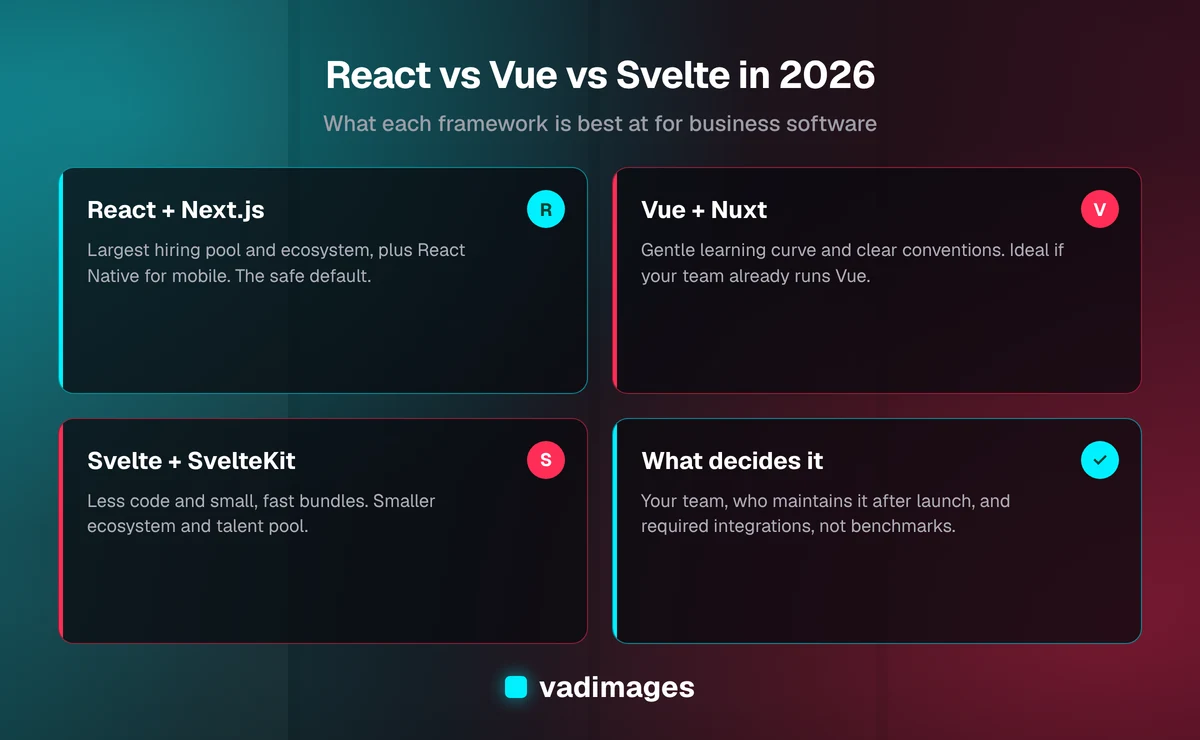
React is the safe default for business software in 2026 because it has the largest ecosystem and the largest pool of developers who already know it. React was created at Meta, and in late 2025 Meta announced it would move React and React Native to a new React Foundation under the Linux Foundation, which puts its governance in a neutral, multi-company home. React 19 made Server Components and Actions part of the stable library, and the React Compiler reached its 1.0 release in 2025, which removes much of the manual performance tuning that older React code needed.
In practice, React is usually used through Next.js, a framework maintained by Vercel that handles routing, server rendering, static export, and API routes. The Vadimages website itself is built with Next.js and React.
- Strengths: the deepest library ecosystem (forms, tables, charts, maps, auth, payments), the most tutorials and answered questions, the easiest hiring, and React Native if you later need a mobile app that shares skills with the web team.
- Weaknesses: more decisions to make (state management, data fetching, styling), more boilerplate than Vue or Svelte, and the Server Components model adds concepts that some developers find confusing.
- Best fit: SaaS products, customer portals, multi-role internal tools, and any project where you expect to hand the code to another team or hire in-house later.
Vue in 2026: the approachable, well-organized middle path
Vue is the approachable middle path in 2026: it is easier to learn than React, more structured out of the box, and backed by a large, stable community. Vue was created by Evan You and is developed by an independent core team funded by sponsors rather than by a single large company. Vue 3 uses the Composition API and a fine-grained reactivity system, and the core team has been developing "Vapor Mode," a compilation strategy that skips the virtual DOM for faster rendering.
Vue is usually paired with Nuxt for server rendering and routing, and with Pinia for shared state. Vue's single-file components keep the template, logic, and styles of a screen in one readable file, which many teams find easier to review.
- Strengths: gentle learning curve, official answers for routing and state management (fewer stack debates), clear documentation, and strong adoption in Laravel and PHP shops through tools such as Inertia.js.
- Weaknesses: a smaller pool of senior developers in the US than React, fewer third-party enterprise components, and a slower path to a native mobile app.
- Best fit: teams that already run Vue or Laravel, admin panels and internal tools, and organizations that value convention over flexibility.
Svelte in 2026: less code, smaller bundles, smaller ecosystem
Svelte is the framework that writes the least code and ships the smallest JavaScript bundles in 2026, at the cost of a smaller ecosystem and hiring pool. Svelte was created by Rich Harris, who works on it full time at Vercel. Svelte is a compiler: it turns your components into plain JavaScript at build time instead of shipping a large runtime library to the browser. Svelte 5, released in 2024, introduced "runes," an explicit reactivity syntax that makes larger Svelte apps easier to reason about.
SvelteKit is Svelte's official application framework, covering routing, server rendering, forms, and adapters for most hosting platforms.
- Strengths: very readable components, small bundles that load quickly on slow phones and networks, and high developer satisfaction in surveys such as State of JavaScript.
- Weaknesses: fewer ready-made enterprise components (complex data grids, scheduling widgets, rich text editors) designed for it, fewer experienced Svelte developers to hire, and the Svelte 5 upgrade showed that large syntax changes can still happen.
- Best fit: marketing sites with interactive pieces, embedded widgets, lightweight dashboards, and products owned long term by one team that already likes Svelte.
React vs Vue vs Svelte: side-by-side for business owners
The side-by-side comparison below translates the technical differences between React, Vue, and Svelte into the questions a business owner or operations lead actually asks, as of 2026.
- Hiring and handover: React is easiest, Vue is good, Svelte is hardest. If you plan to bring development in-house within two years, this factor usually outweighs everything else.
- Ready-made components and integrations: React has the most, Vue has plenty, Svelte has fewer. Payment providers such as Stripe, auth providers, mapping SDKs, and charting libraries usually publish React components first.
- Code volume for the same feature: Svelte is the most concise, Vue is close behind, React is the most verbose. Less code means faster reviews, not necessarily a cheaper project.
- Learning curve for a new developer: Vue and Svelte are gentler; React with Next.js and Server Components has the most concepts to learn.
- Mobile app path: React has React Native; Vue and Svelte typically rely on wrappers such as Capacitor, or a separate native app.
- Governance: as of 2026, React is moving to the React Foundation under the Linux Foundation; Vue is independent and sponsor-funded, while Nuxt's core team works at Vercel after Vercel acquired NuxtLabs in 2025; Svelte's lead maintainer is also employed by Vercel. All three frameworks are MIT-licensed.
How we choose a framework for a client project
At Vadimages we choose the front-end framework with the same short checklist on every project, and we write the reasoning into the proposal so the client can see the trade-off. The checklist runs in this order because the early questions eliminate options fastest.
- What does your team already run? If you have an existing Vue or React codebase or developers who know one of them, staying with it almost always wins. Two front-end frameworks in one company doubles the maintenance burden.
- Who maintains the app after launch? If the answer is "we will hire," pick the framework with the biggest local hiring pool, which in most US markets is React.
- Which integrations are required? We list every third-party service (QuickBooks Online, Stripe, HubSpot, a mapping provider, an e-signature tool) and check which have maintained SDKs or components for each framework.
- Is there a mobile app on the roadmap? A likely native app tilts the decision toward React because of React Native.
- How sensitive is the audience to load time? Field crews on phones with weak signal, or a public site that depends on search traffic, can justify Svelte or extra performance work in any framework.
For most of the business apps we build, that checklist ends at React with Next.js and TypeScript. We do not treat that as a rule: when a client already runs Vue, we build in Vue. You can see the full delivery process on our how we work page.
What the framework choice does and does not change about cost
The framework choice changes the cost of a business web app much less than the scope does. Budget is driven by the number of screens, user roles, workflows, and integrations, plus data migration and testing. As of 2026, Vadimages projects start at $5,000; typical custom business systems and SaaS MVPs run $50,000 to $150,000, internal tools run $30,000 to $75,000, and marketing websites run $8,000 to $35,000, whichever of the three frameworks we use. See our pricing page for how those ranges are set.
Where the framework does affect cost is over the life of the app. A niche choice can make it slower and more expensive to find a developer for a change two years from now, and a framework with fewer ready-made components can mean building a data grid or scheduler from scratch. Those are the costs to weigh, not a few kilobytes of JavaScript.
Common mistakes when picking a front-end framework
The most common mistake small businesses make when picking a front-end framework is letting a single developer's preference decide a stack the company will own for years. Other front-end framework mistakes the Vadimages team sees when taking over existing projects:
- Choosing on benchmarks alone. Synthetic framework benchmarks measure rendering thousands of rows; your app's speed is usually limited by its API and database.
- Rewriting a working app to switch frameworks. A rewrite rarely pays back unless the current framework version is unsupported or the code is unmaintainable. Incremental upgrades are cheaper.
- Skipping TypeScript. All three frameworks support TypeScript well in 2026, and typed code is far easier for the next developer to change safely.
- Ignoring hosting and rendering. Whether pages render on the server, at build time, or in the browser affects search visibility and speed more than the framework name. Decide it early.
If you want to see how these decisions play out on real builds, browse our case studies and the solutions we offer for portals, internal tools, and SaaS products. Our industries page shows the kinds of teams we usually build for.
Frequently asked questions
Is React still the best choice in 2026?
React is still the best default choice for most business web apps in 2026 because of its ecosystem, hiring pool, and React Native path to mobile, but it is not automatically the best choice for every project. If your team already uses Vue, or the project is a small, performance-focused widget, Vue or Svelte can be the better fit.
Is Svelte faster than React?
Svelte usually ships less JavaScript than React and can load and update faster in benchmarks, because it compiles components to plain JavaScript instead of shipping a runtime. In a typical business app, though, API response times, images, and third-party scripts affect perceived speed far more than the choice between Svelte and React.
Should we rewrite our Vue app in React?
You should not rewrite a working Vue app in React just to follow popularity. A rewrite makes sense only when the current code is on an unsupported version, cannot be maintained, or blocks a specific requirement such as a shared React Native mobile app. Upgrading Vue in place is usually cheaper and less risky.
Which framework is easiest to hire for in the US?
React is the easiest of the three to hire for in the US, since it has been the most-used front-end framework in the Stack Overflow Developer Survey and State of JavaScript survey for years. Vue developers are available but fewer, and experienced Svelte developers are the hardest to find.
Does the framework change what Vadimages charges?
The framework does not change what Vadimages charges; scope does. As of 2026, projects start at $5,000, with custom business systems typically $50,000 to $150,000 and internal tools $30,000 to $75,000 depending on workflows, roles, and integrations.
Not sure which stack fits your project? Tell us what you need to build and who will maintain it, and our Vancouver, WA team will recommend a framework with the reasoning written down. Contact Vadimages to describe your project and get a written estimate.


