

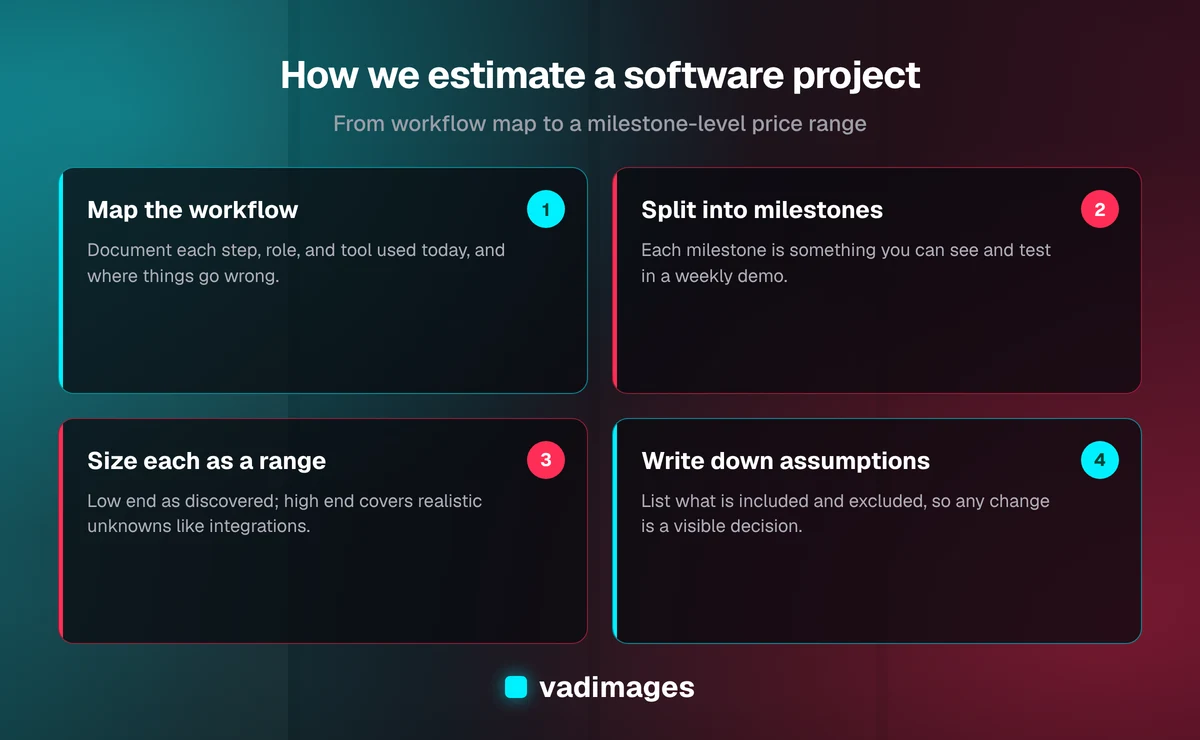
Software project estimation is the process of turning a business goal into a scoped list of work, sizing each piece, and stating a price range and timeline along with the assumptions behind them. At Vadimages, we estimate a project in four steps: map the workflow, break it into milestones, size each milestone as a low–high range, and write down what is included, what is excluded, and what would move the number. This article walks through that process and then shows a worked software project estimation example for a representative internal tool, priced at $41,000–$56,000 over 10–12 weeks as of 2026.
This guide from Vadimages' engineering team is written for US small and mid-sized business owners and operations leads who have asked a developer "how much will this cost?" and received either a single number with no explanation or a vague "it depends." We are a custom software studio in Vancouver, WA, and we price by fixed scope and milestones, not by the hour. The order exception tool example in this article is a representative composite built from the kinds of internal tools we scope, not a specific client project.
Why a software estimate is a range, not a single number
A software estimate is a range because some of the work is unknown until you build it: how messy the existing data is, how an outside system's API behaves, or how many edge cases a workflow really has. An honest estimate shows that uncertainty instead of hiding it. A single number either has padding buried inside it or will be exceeded later.
What matters is that the range narrows over time and that you can see why. A rough range in the first call is useful for deciding whether a project fits your budget. A milestone-level range after discovery is what you sign. Weekly demos during the build then show whether each milestone is landing at the low end or the high end of its range.
We use three levels of estimate, and we tell clients which one they are looking at:
- Ballpark (first conversation): a wide range based on similar projects, such as "internal tools usually run $30,000–$75,000 as of 2026." Good for a go/no-go decision, not for a contract.
- Scoped estimate (after discovery): a range per milestone, with assumptions and exclusions written down. This is the number the project is priced on.
- Milestone confirmation (during the build): each milestone's acceptance criteria are agreed before work starts, so a change in scope becomes a visible decision, not a surprise invoice.
How we estimate a software project, step by step
Our estimating process follows the first two phases of how we work: discovery and system design, then scope and roadmap. Each phase takes about a week for a typical project. The four core steps (map, split into milestones, size, and document assumptions) expand into six steps in practice:
- Map the current workflow. We talk to the people who do the work today and document each step, who does it, which tools they use (spreadsheets, QuickBooks Online, Shopify, email), and where things go wrong. The estimate is only as good as this map.
- Define the outcome. We agree what "done" means in business terms, for example "every order exception is assigned and resolved inside the tool, without email threads."
- Break the work into milestones. Each milestone is something you can see and test in a demo: login and roles, a core workflow screen, an integration, a report. Milestones keep the estimate tied to visible results.
- Size each milestone as a low–high range. The low end assumes things go as discovered; the high end covers the realistic unknowns for that milestone. Risky items (integrations, data migration) get wider ranges than well-understood ones (standard forms and lists).
- Write down assumptions and exclusions. Every range rests on assumptions, such as "the Shopify store uses standard order fields." If an assumption turns out false, both sides know exactly why the estimate changes.
- Set the timeline from the milestone order. Calendar time depends on dependencies and on how fast decisions and feedback come back, not just on effort.
What drives the cost of a software project
The cost of a custom software project is driven mainly by how many distinct workflows and user roles it supports, how many outside systems it connects to, and how much existing data has to move. Screen count matters less than most people expect. A tool with ten simple screens can cost less than a tool with three screens and two complicated integrations.
The factors we size, as listed on our pricing page, are:
- Number of workflows and roles. Each workflow (for example, "log an exception, assign it, resolve it") and each role with different permissions adds design, build, and testing work.
- Integrations and data sources. Connecting to QuickBooks Online, Shopify, a CRM such as HubSpot or Salesforce, or a carrier API such as UPS or FedEx means handling authentication, rate limits, errors, and sync rules. Integrations are usually the widest ranges in an estimate.
- Security and compliance requirements. Audit logs, single sign-on, or HIPAA-related controls add defined work that has to be designed in from the start.
- Migration and legacy constraints. Moving years of spreadsheet or legacy-database records means cleaning, mapping, and verifying data before launch.
- Deployment and support needs. Hosting, monitoring, backups, and the level of support after launch.
A software project estimation example: an order exception tool
This software project estimation example is a representative composite, not a real client. It describes a 30-person wholesale distributor that sells through Shopify and keeps its books in QuickBooks Online. Today, order problems (out-of-stock items, address errors, payment holds) are tracked in a shared spreadsheet and email threads. Orders get missed, nobody knows who owns a problem, and the owner cannot see how many exceptions are open at any time.
The goal and the scope
The goal agreed in discovery: every order exception for the distributor is captured automatically or logged in one place, assigned to a named person, and resolved with a full history, and the owner sees open and overdue exceptions on one dashboard. In scope are three roles (staff, team lead, owner), one core workflow, two integrations (Shopify orders in, QuickBooks Online customer and invoice status in), and a dashboard with two reports.
The milestone breakdown
The scoped estimate for the representative order exception tool, as of 2026, is split into six milestones, each with a low–high range:
- Discovery and system blueprint: $4,000–$5,000. Workflow map, data model, screen outline, integration plan, and the milestone plan itself.
- Foundation, login, and roles: $7,000–$9,000. User accounts, the three roles and their permissions, the core data model, hosting, and deployment pipeline.
- Exception workflow: $12,000–$16,000. Create, assign, comment on, and resolve exceptions; status rules; email notifications; full history on every exception. This is the heart of the tool and the largest milestone.
- Shopify and QuickBooks Online integrations: $9,000–$13,000. Pull new orders and flagged orders from Shopify; read customer and invoice status from QuickBooks Online; handle sync errors and retries. The range is wide because API behavior and data quality are only fully known once the connection is live.
- Dashboard and reports: $5,000–$7,000. Open and overdue exceptions by type and owner, plus an exception history report the owner can export.
- QA, launch, and stabilization: $4,000–$6,000. Testing against the acceptance criteria, a go-live plan, monitoring setup, and a stabilization period after launch.
Added together, the six milestones of the representative order exception tool total $41,000 at the low end and $56,000 at the high end. That sits inside the $30,000–$75,000 range we quote for internal tools development as of 2026. The timeline is 10–12 weeks: about one week each for discovery and scoping, seven to nine weeks of build with weekly demos, and a launch week.
Assumptions and exclusions
The estimate for the order exception tool rests on written assumptions. If one of them proves false, the affected milestone is re-estimated before work continues:
- The Shopify store uses standard order and fulfillment fields, with no heavy custom apps rewriting order data.
- QuickBooks Online is read-only for this phase; the tool does not create or edit invoices.
- Old spreadsheet records are not migrated; the tool starts clean on launch day, and the spreadsheet is archived.
- The client names one point of contact who can make scope decisions and give demo feedback within two business days.
Excluded from this estimate are a customer-facing portal, a mobile app, and writing data back to QuickBooks Online. Each of those is a sensible phase two, and each would be estimated the same way, as its own milestone.
What moves an estimate up or down
An estimate moves up when scope or risk is added and down when it is removed. In the order exception example, the biggest levers are easy to see because each one maps to a milestone:
- Writing to QuickBooks Online instead of only reading. Creating credit memos or invoice adjustments adds validation, error handling, and accounting review, and widens the integration milestone.
- Migrating history. Bringing two years of spreadsheet records into the new tool adds a data cleanup and mapping milestone.
- More roles or approval steps. A fourth role with its own approval path adds permissions work and testing to the foundation and workflow milestones.
- Cutting to the core. Launching with the Shopify integration only, and adding QuickBooks Online later, lowers the first phase and gets the team using the tool sooner.
Slow decisions also move the timeline, and sometimes the price. A demo that waits two weeks for feedback stretches the calendar even when the effort is unchanged. That is why "fast feedback on demos" and "decision-making on scope tradeoffs" are listed as client responsibilities on our How We Work page.
How to compare estimates from different developers
To compare software estimates fairly, compare what each one includes, not just the total. Two quotes for "an order management tool" can describe very different products. Ask each developer for the same things:
- A milestone or feature breakdown with a range for each part, so you can see where the money goes.
- Written assumptions and exclusions, so you know what is not in the price.
- How changes are handled: whether new requests are estimated as their own items or absorbed until the budget runs out.
- What happens after launch: stabilization, bug fixes, hosting, and the cost of ongoing support.
- Examples of similar work, such as the projects in our case studies, so you can judge whether the team has built something comparable.
A much lower quote is not automatically a bad sign, but it usually means something is missing from scope: an integration treated as trivial, no testing milestone, or no time for launch support. A breakdown makes that visible before you sign.
Frequently asked questions
How accurate is a software project estimate?
A software project estimate is as accurate as the discovery behind it. A ballpark from a first call can be off by a wide margin; a scoped estimate built from a workflow map, milestone breakdown, and written assumptions is far more reliable, and milestone acceptance criteria keep any change visible and agreed before it is built.
What is included in a Vadimages project estimate?
A Vadimages scoped estimate includes a milestone plan with a low–high price range for each milestone, acceptance criteria for each milestone, a delivery timeline, and a written list of assumptions and exclusions. It comes out of the discovery and scope phases, which take about a week each on a typical project.
Why do you price by milestones instead of by the hour?
Vadimages prices by fixed scope and milestones because it ties the price to results you can see in a demo. You know what each milestone costs and what it delivers before it starts, instead of watching hours accumulate without a clear link to finished work.
How long does a typical custom software project take?
As of 2026, most Vadimages engagements run 6–16 weeks from discovery through launch. Internal tools typically take 6–12 weeks, while multi-workflow business systems and SaaS MVPs take 10–16 weeks. The representative order exception tool in this article lands at 10–12 weeks because of its two integrations (Shopify and QuickBooks Online).
What is the smallest project you take on?
As of 2026, Vadimages website projects start at $4,000. Custom software usually starts higher: a single system integration typically runs $15,000–$60,000 and an internal tool $30,000–$75,000, as shown on our pricing page. Smaller budgets are usually scoped as one tightly bounded automation or integration.
Get an estimate for your project
If you have a workflow that lives in spreadsheets and email, we can give you a ballpark range in a first conversation and a milestone-level estimate after discovery, with every assumption written down. Browse our custom software solutions and the industries we build for to see what we build, then contact Vadimages to talk through your project.


