
More and more buying decisions now start with a question typed into ChatGPT or Perplexity, not a search box. Someone asks, "Who builds custom software for small businesses in the Pacific Northwest?" or "What should a healthcare practice look for in a development partner?" — and the assistant answers in a few confident sentences, naming a handful of companies and linking to a few sources. If your business is one of those named sources, you just earned a warm introduction to a buyer at the exact moment they were deciding. If it is not, you are invisible in a conversation that used to happen on your website. Learning how to get cited by AI is quickly becoming as important as ranking on Google was ten years ago, and the good news is that most of the work rewards the same habits that make you genuinely useful to human readers.
Why being cited by AI is the new front page
Traditional search gives someone ten blue links and asks them to do the work of comparing. AI assistants do the comparing for the user and hand back a short list with reasons. That changes the game in two ways. First, there are far fewer "slots" — an answer might name three or four companies instead of a page of ten, so the difference between being included and being left out is stark. Second, an AI citation carries a quiet endorsement. When an assistant says "companies like yours are known for transparent pricing and fast delivery," the buyer reads that as a recommendation, not an ad. That trust is exactly why getting cited matters more than getting clicked.
It also compounds. The businesses that show up in AI answers today are the ones that published clear, credible, well-structured information over the past year or two. The assistants learned to trust them, and that trust is sticky. Starting now means you are building the reputation these systems will lean on for the next several years, not scrambling to catch up after your competitors are already the default answer.
How ChatGPT and Perplexity actually decide what to cite
You do not need to understand the math to work with these systems, but you do need a mental model. When someone asks a question, a modern assistant does not simply recite what it memorized during training. It runs a live search, pulls back a set of candidate pages, reads them, and then writes an answer grounded in the ones it finds clearest and most trustworthy. Perplexity does this openly, showing its sources next to the answer. ChatGPT does it through its browsing and search features, citing pages it consulted. In both cases the assistant is choosing which sources to quote, and that choice is where your opportunity lives.
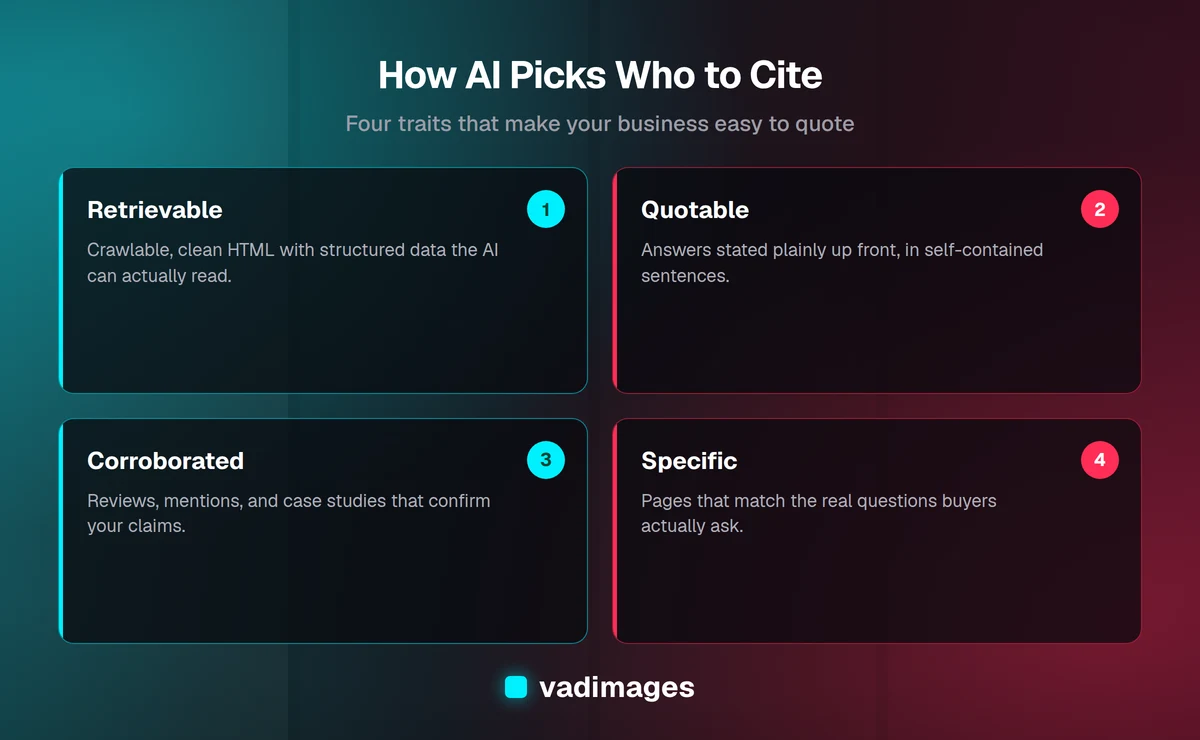
Three things drive that choice. The page has to be retrievable — the assistant's crawler must be able to reach it, read it, and understand what it is about. It has to be quotable — the answer to the user's question has to be stated plainly enough that the model can lift a clean sentence or two without guessing. And the source has to be corroborated — the same facts, reputation, and mentions should appear in more than one place the model already trusts. Miss any one of these and you tend to get skipped, even if your work is excellent. Nail all three and you become the easy, safe source to cite.
Make your pages easy to quote
The single highest-leverage change most businesses can make is to answer questions directly, at the top, in plain language. Assistants reward pages that lead with the answer and then explain, because that is the shape of text they can quote without risk. If your page buries the useful sentence in paragraph nine, the model has to work harder to extract it — and it will often prefer a competitor who put it first.
A few practical habits make your content far more quotable:
- State the answer in the first two sentences of a section, then use the rest to add nuance, caveats, and examples.
- Write self-contained claims. "Custom software projects typically start around $5,000 and scale with complexity" can be quoted as-is; "it depends on your needs" cannot.
- Use clear question-shaped headings. Headings like "What does custom software cost?" mirror how people phrase things to an assistant, which helps it match your page to the question.
- Prefer concrete specifics over vague adjectives. Numbers, ranges, timelines, and named steps give the model something solid to cite instead of marketing fluff it will ignore.
- Keep sentences readable. Short, declarative sentences survive being pulled out of context; long, comma-spliced ones get mangled or dropped.
This is the same clarity that helps a busy human skim your page and decide you know what you are talking about. Writing for the assistant and writing well for people are, happily, almost the same task. Our own how-we-work and pricing pages are built this way on purpose: they answer the obvious questions in the first line so a reader — or a model — never has to dig.
Build the kind of evidence AI trusts
Assistants are trained to be cautious about who they recommend, so a claim that only appears on your own website carries less weight than the same claim confirmed elsewhere. This is where reputation does real work. When your company name shows up in directories, review sites, industry roundups, podcast notes, and other people's articles — all saying broadly consistent things about what you do — the model gains confidence that you are a real, credible option and becomes far more willing to name you.
You cannot fake this, but you can steadily build it. Encourage satisfied clients to leave reviews on the platforms that matter in your industry. Publish real case studies with specifics a third party could verify. Get listed accurately in the directories buyers in your space actually use. When you are interviewed, quoted, or featured, make sure your name and what you do are stated clearly. Every consistent mention is another data point that tells an assistant your business is the safe answer to a buyer's question.
Get the technical foundation right
None of the above matters if the assistant's crawler cannot reach or parse your pages. The technical bar is not high, but it is unforgiving — a page that is invisible to a crawler is invisible to the AI, full stop. Most of this is straightforward web hygiene that a good development partner handles as a matter of course:
- Serve real HTML. If your key content only appears after heavy JavaScript runs, some crawlers will miss it. Make sure the words are in the page a crawler receives.
- Do not block the new crawlers. Check that your robots rules allow the AI user agents you want to reach you, rather than quietly denying them.
- Add structured data. Schema markup for your organization, articles, FAQs, and reviews gives machines an unambiguous description of what each page is and who you are.
- Keep pages fast and stable. Slow or flaky pages get crawled less thoroughly, so performance quietly affects how much of your content is ever read.
- Use clean, descriptive URLs and titles. A URL and page title that plainly say what the page covers help both search and AI systems file it correctly.
If you are not sure where your site stands on any of this, it is worth a focused audit. These are exactly the kinds of fixes we fold into a custom build or a website modernization, because they pay off across search, AI answers, and plain everyday usability all at once.
Show up for the specific questions buyers ask
Broad, generic pages rarely get cited, because assistants are answering specific questions. "Software company" is a category; "custom inventory software for a distributor in Vancouver, WA" is a question with a real buyer behind it. The businesses that win AI citations tend to have pages that map closely to those narrower, higher-intent questions — the industry you serve, the problem you solve, the region you work in, and the way you actually engage.
Think about the entities that describe your business and make sure each one has a clear home on your site. Who you serve belongs on your industries pages. What you build and the outcomes it drives belong on your solutions pages. The more precisely your content matches the real language of a buyer's question, the more often an assistant will find you to be the obviously relevant source. This is also why a steady stream of focused articles — each answering one genuine question well — beats a single sprawling page trying to cover everything.
Measure whether it is actually working
Getting cited by AI is not a vanity project, so treat it like any other channel and watch for signal. The measurement is a little different from classic SEO, because a citation may not always send a click, but there are clear ways to tell it is moving:
- Ask the assistants directly. Periodically pose the questions your buyers would ask and note whether — and how — your business gets named and what it says about you.
- Watch for referral traffic from AI tools. Visits from ChatGPT, Perplexity, and similar sources show up in analytics and tend to be unusually high-intent.
- Track branded questions. A rise in people searching or asking for your company by name often follows an increase in AI mentions.
- Listen on sales calls. "I asked ChatGPT and it mentioned you" is the clearest proof of all, and it is worth logging when you hear it.
You do not need a fancy dashboard to start. A simple monthly check — the same handful of questions, asked the same way, with notes on what changed — will tell you whether your investment is paying off and where to push next.
What to realistically expect
This is a compounding effort, not a switch you flip. In the first month or two you are mostly fixing foundations — making pages retrievable, rewriting them to answer questions directly, and adding structured data. Over the following months, as crawlers re-read your improved pages and as more consistent mentions of your business accumulate around the web, you start to see your name appear in answers more often and for more specific questions. It behaves much more like building a reputation than running an ad campaign, which is precisely why it is durable once it takes hold.
The businesses that treat this seriously now will be the default answers their competitors are compared against later. That is a strong position to be in, and it is available to any company willing to be genuinely clear, credible, and technically sound.
Where Vadimages fits
At Vadimages we build custom software and websites for US small and mid-sized businesses, and getting our clients cited by AI is now part of how we think about every build. That means clean, crawlable HTML, structured data baked in, content architected around the real questions buyers ask, and a foundation that performs. We are based in Vancouver, WA, we price transparently with projects starting around $5,000, and we are happy to start with a plain-English look at where your site stands today. If you want to be the business ChatGPT and Perplexity name when a buyer asks, get in touch — or read more about how we work and what a project with us looks like.