
If you are building a software product that more than one company will pay to use, you have already made a decision about multi tenant SaaS architecture — whether you meant to or not. Every SaaS app has to answer one basic question: when Customer A and Customer B both log in, how does the software keep their data separate while running on the same system? The way you answer that shapes your security posture, your monthly hosting bill, how fast you can onboard a new customer, and how much a future rebuild will cost. This guide explains multi-tenancy in plain English, walks through the real trade-offs, and shows you which model fits a company at your stage.
What "multi-tenant" actually means
A tenant is a customer — usually a whole company, along with all of its users and data. Multi-tenancy means many tenants share the same running application and, often, the same database, while each one sees only its own slice of the world. Think of an apartment building: everyone shares the foundation, the plumbing, and the roof, but each unit has its own locked door and no one can wander into a neighbor's living room. The alternative — single-tenancy — is more like building a separate house for every customer. Each gets total isolation, but you now maintain a whole street of houses instead of one building.
Almost every modern SaaS product you use daily — your CRM, your accounting tool, your project tracker — is multi-tenant. It is the default for a reason: one codebase, one deployment, and one place to ship a bug fix or a new feature that instantly reaches every customer. That efficiency is exactly why multi-tenant apps can charge $30 a month instead of $30,000. But "share the building" hides a lot of engineering decisions, and the biggest one is how you separate the data.
Why founders should care before a line of code is written
It is tempting to treat architecture as an engineering detail and stay focused on the demo. The problem is that the tenancy model is one of the hardest things to change later. It touches your database, your login flow, your billing, your backups, and every query in the app. Founders who ignore it early often hit a wall around their 20th or 50th customer — the app slows down, one customer's export accidentally includes another customer's rows, or a security review from an enterprise buyer stalls the whole deal. Fixing tenancy after launch is not a weekend task; it is frequently a partial rewrite.
You do not need to write the code yourself, and you do not need to know how database indexes work. You do need to understand the three common models well enough to ask your team — or your custom software partner — the right questions and to recognize when an answer is a red flag. That is the entire goal of this article.
The three ways to separate tenant data
There is a spectrum from "everything shared" to "nothing shared." Three points on that spectrum cover the vast majority of real products.
1. Shared database, shared tables (row-level). Every tenant's records live in the same tables, and each row carries a tenant_id column that marks who it belongs to. The application filters every query by that ID so Customer A only ever sees rows tagged with their ID. This is the cheapest and simplest model to run, and it scales to thousands of customers on modest infrastructure. The catch is that isolation is enforced entirely in software — one missing filter in one query and data can leak across tenants. Discipline and good tooling matter enormously here.
2. Shared database, separate schemas. Each tenant gets its own schema — a named container of tables — inside one shared database server. Customer A's tables and Customer B's tables have the same structure but live in separate namespaces. Isolation is stronger because the database itself keeps tenants apart, and it is easier to export or delete a single customer. The cost is complexity: schema changes now have to be applied across every tenant, and thousands of schemas can strain a single database server.
3. Separate database per tenant. Every customer gets their own database, sometimes on their own server. This is the strongest isolation short of fully separate applications, and it is often what regulated buyers in healthcare or finance ask for. It also gives you a clean story for data residency and per-customer backups. The trade-off is operational weight and cost — more databases to provision, patch, monitor, and pay for — which is why it usually shows up for a smaller number of higher-value enterprise accounts rather than for a self-serve product with a free tier.
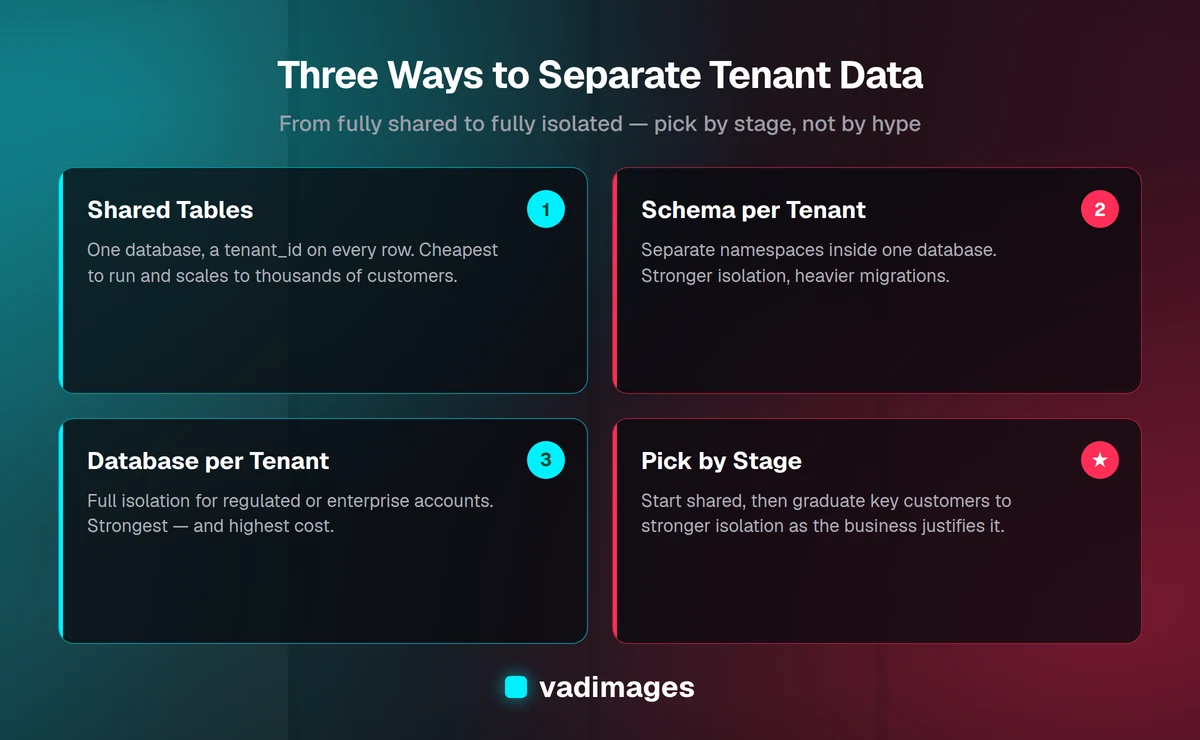
Many mature products end up using a hybrid: shared tables for the long tail of small self-serve customers, and a dedicated database for the handful of enterprise accounts that require it. That is a perfectly valid destination — but it is a place you grow into deliberately, not where most products should start.
How to pick the right model for your stage
For most early-stage SaaS products serving small and mid-sized businesses, the shared-table model is the right starting point. It gets you to market fastest, costs the least to run, and keeps your team focused on the features customers actually pay for instead of on infrastructure plumbing. The engineering effort saved in the first year is real money you can put toward product and sales.
You should consider a stronger model earlier if any of these are true for your market:
- You sell into regulated industries — healthcare, finance, legal — where buyers demand data isolation in writing. Our work across industries shows this requirement surfacing in the very first security questionnaire.
- A single customer holds an outsized share of revenue and wants contractual guarantees about where their data lives and how it is backed up.
- You expect very large tenants whose data volume alone would slow a shared table for everyone else.
- You need per-customer data residency — keeping EU data in the EU, for example.
If none of those apply yet, start simple and design so you can graduate specific customers to stronger isolation later. The key phrase is "design so you can" — a clean tenant_id on every table and a single, central place that enforces the tenant filter make a future move dramatically cheaper than one bolted on after the fact.
Keeping tenants isolated and data secure
The single scariest failure mode in a SaaS product is cross-tenant data leakage — one customer seeing another customer's records. In a shared-table model this is a one-line mistake away, so the defense has to be structural rather than something each developer remembers to do. Strong teams enforce the tenant filter in a shared data-access layer that every query passes through, so it is impossible to write a query that forgets it. Some databases also offer row-level security, where the database itself refuses to return rows outside the current tenant even if the application code slips.
Beyond query filtering, isolation also means separating file storage, background jobs, and caches by tenant, and making sure an admin from one company can never be granted access to another. These are solvable problems, but they need to be designed in from the start and verified with automated tests. When we scope a SaaS build, cross-tenant isolation testing is a non-negotiable line item — you can see how we approach that kind of rigor in how we work.
The "noisy neighbor" problem
Because tenants share resources, one heavy customer can degrade performance for everyone — the classic noisy neighbor. A single tenant running a massive report or importing a million records can slow the whole application if nothing limits them. Founders feel this as mysterious slowdowns that support cannot reproduce, because the cause is another customer entirely.
The fixes are well understood: rate limits per tenant, queuing heavy jobs so they run in the background, and monitoring that attributes load to the specific customer causing it. For the largest accounts, moving them to a dedicated database or dedicated compute removes the shared bottleneck entirely. None of this requires exotic technology — it requires that someone planned for it before a big customer arrived, rather than after they started complaining.
Customizing per customer without forking your code
Sooner or later a customer will ask for something specific: their logo on the login screen, an extra field on a form, a custom approval step, or a report laid out their way. The wrong answer is to copy the codebase and maintain a separate version for that customer — do that a few times and you have several products to keep in sync, and every bug fix has to be applied everywhere. Multi-tenant products handle this with configuration, not forking: feature flags, per-tenant settings, custom fields, and white-label branding that all live in data, so one codebase behaves differently for each customer based on their settings.
Designing that flexibility in early is far cheaper than retrofitting it. It is also what lets a lean team serve wildly different customers from one product — the difference between a business that scales and one that drowns in one-off maintenance. If your roadmap already hints at heavy per-customer customization, that is worth surfacing when you plan your solutions so the architecture accounts for it.
What multi-tenancy costs — and saves
The appeal of multi-tenancy is leverage. One deployment, one codebase, and shared infrastructure mean your cost to serve each additional customer is small, which is the whole economic engine behind SaaS. Adding your 200th customer to a well-built shared-table app might cost you almost nothing in new infrastructure. That is what makes low monthly pricing sustainable and gross margins healthy.
Stronger isolation trades some of that leverage for security and control. A database per tenant means real per-customer cost — provisioning, patching, backups, and monitoring multiplied across every account — which is why it is usually reserved for accounts whose contract value justifies it. The honest framing for a founder is a business decision, not a purely technical one: which customers are worth the extra cost of stronger isolation, and which are served perfectly well by the shared model? We build software for US small and mid-sized businesses with transparent pricing that starts at $5,000, and we are direct about these trade-offs up front — our pricing page lays out how we scope this rather than hiding it in a change order later.
Common mistakes founders make
A few patterns come up again and again, and every one of them is avoidable:
- Skipping the
tenant_iddiscipline. Adding it later, once tables are full of data and queries assume it is absent, is painful and risky. Put it on every tenant-owned table from day one. - Over-engineering for scale you do not have. Building a database-per-tenant platform for a product with three customers burns your runway on infrastructure instead of on finding product-market fit.
- Enforcing isolation in scattered code. If the tenant filter lives in a hundred different queries, one of them will eventually be wrong. Centralize it.
- Forking the codebase for custom requests. Configuration scales; copies do not.
- Treating tenancy as final. The best designs let you promote a specific customer to stronger isolation without rewriting the app.
You can see the difference disciplined architecture makes in our case studies, where the products that scaled cleanly are the ones that got these fundamentals right early.
Where Vadimages fits
Multi-tenant architecture is not something you have to master personally — but as a founder you should understand it well enough to make an informed call and to know when your team's answers hold up. The short version: for most SMB-focused SaaS products, start with a shared database and clean tenant isolation, design so individual customers can graduate to stronger isolation when the business justifies it, enforce separation structurally, and handle customization through configuration rather than copies. Get those fundamentals right and your product can grow from three customers to three thousand on the same foundation.
Vadimages builds custom SaaS products for US small and mid-sized businesses from our base in Vancouver, WA, with transparent pricing starting at $5,000 and a plain-English approach to the trade-offs that actually affect your bottom line. If you are planning a SaaS product and want a partner who will design the tenancy model around your real customers and budget — not a generic template — get in touch and we will map out the right approach for your stage.