
A well-structured Google Ads account works like a well-organized filing cabinet: campaigns hold your budgets and targeting, ad groups hold tightly themed keywords, and every ad speaks directly to the searches it was built for. Get your google ads campaign structure right and the whole account reinforces itself — your ads stay relevant, your Quality Score climbs, your cost per click falls, and your reports actually tell you where the money is going. Get it wrong and you pay more for worse placement while flying blind on what's working.
Most wasted ad spend isn't caused by a bad bid or a weak headline. It's caused by a messy structure that makes everything downstream harder. This guide walks through how a Google Ads account is organized, how to decide what becomes a campaign versus an ad group, and the structural choices that separate a tidy, profitable account from an expensive guessing game.
The four levels of a Google Ads account
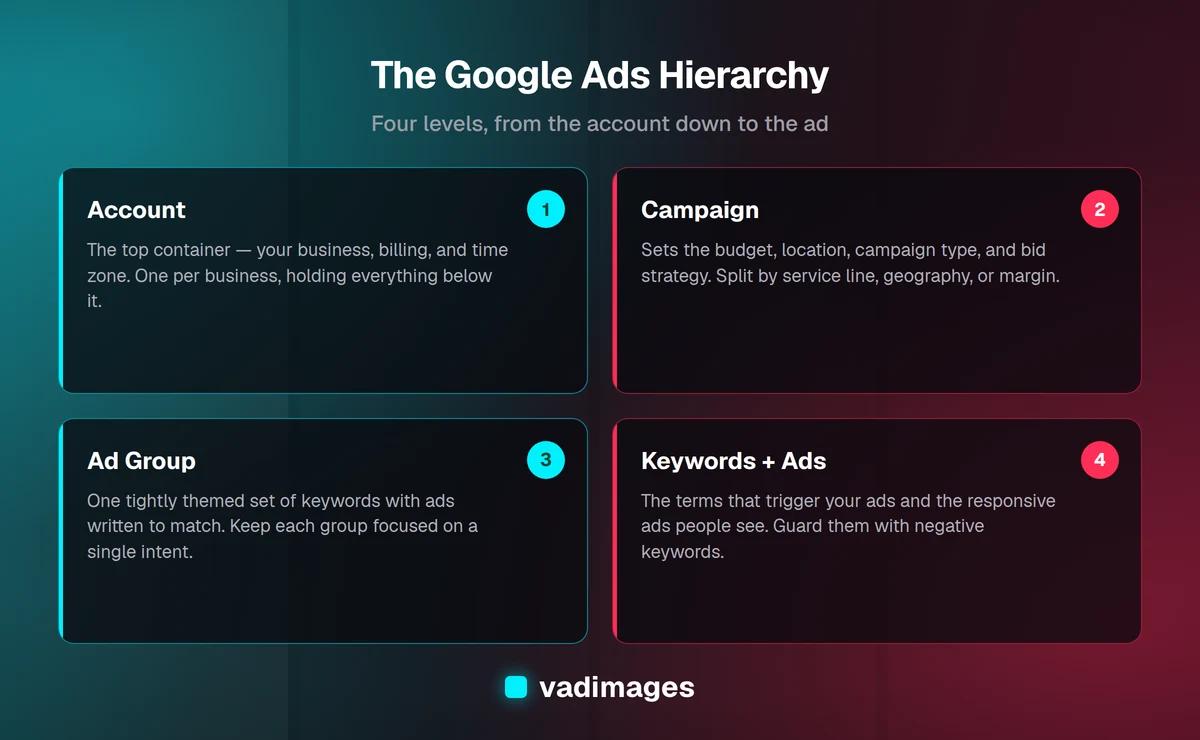
Every Google Ads account nests in the same top-down hierarchy. Understanding what each level controls is the foundation for every decision that follows:
- Account — the top container tied to your business, billing, and time zone. You get one per business, and it holds everything below it.
- Campaign — where you set the budget, the location and language targeting, the campaign type (Search, Performance Max, Shopping, Display, Video), and the bid strategy. Think of a campaign as a bucket of money aimed at a defined goal.
- Ad group — a cluster of closely related keywords that share a single theme, plus the ads written specifically for that theme. A campaign can hold many ad groups.
- Keywords and ads — the actual search terms that trigger your ads, and the responsive ads people see. This is the ground floor where the auction actually happens.
Sitting alongside all of this are assets (formerly called extensions) — sitelinks, callouts, call buttons, location info — which can be set at the account, campaign, or ad group level. The golden rule of the hierarchy: settings flow downward. A budget lives at the campaign level, so if two things need separate budgets, they need separate campaigns. A theme lives at the ad group level, so if two sets of keywords deserve different ad copy, they belong in different ad groups.
Why structure matters more than most owners expect
It's tempting to treat structure as busywork and rush straight to writing ads. Resist that. Four concrete things depend on how you organize the account:
Relevance and Quality Score. Google rewards ads that closely match the search behind them with a higher Quality Score, which means lower costs and better positions. A tight ad group — where five closely related keywords all point at one focused ad and one relevant landing page — earns a far better score than fifty scattered keywords sharing a single generic ad. Structure is the single biggest lever you control over Quality Score.
Budget control. Because budgets live at the campaign level, your structure decides where money can and can't flow. If your highest-margin service shares a campaign with a low-value one, they compete for the same daily budget and you can't protect the spend that matters most. Separating them into their own campaigns lets you fund each deliberately.
Reporting clarity. A clean structure is a readable structure. When campaigns map to service lines and ad groups map to themes, a glance at the account tells you which offering is profitable and which is bleeding. When everything is dumped together, the averages hide the truth.
Easier optimization. Every improvement — adding a negative keyword, testing a headline, raising a bid — is faster and safer when the account is organized. You can act on one theme without disturbing the rest.
What should be a campaign?
This is the decision that trips people up most, so here's a simple test: something deserves its own campaign when it needs its own budget, its own geography, its own campaign type, or its own bidding goal. In practice, most small and midsize businesses structure campaigns around one of these dimensions:
- Service or product line. The most common and usually the best starting point. A plumbing company might run separate campaigns for "emergency repair," "water heater installation," and "drain cleaning" so each gets its own budget and its own performance view.
- Geography. If you serve several markets with different values or budgets — say Vancouver, WA versus a broader Portland metro push — separate campaigns let you fund and bid on each independently and read results city by city.
- Priority and margin. Your most profitable offerings deserve protected budgets. Splitting high-margin work into its own campaign stops a cheaper, higher-volume service from eating the spend you'd rather put toward better leads.
- Campaign type. Search, Shopping, and Performance Max behave very differently and should never share a campaign. Keep them separate so you can judge and tune each on its own terms.
A word of caution on going too granular: splitting into dozens of tiny campaigns starves each one of the conversion data that modern bidding needs to learn. For most SMB budgets, a handful of well-defined campaigns beats a sprawling maze. Start consolidated, then split only when a segment is big enough to manage — and fund — on its own.
What should be an ad group?
If a campaign is a bucket of budget, an ad group is a single, focused message. The guiding principle is one theme per ad group. Every keyword in the group should be answerable by the same two or three ads and sent to the same relevant landing page. When a keyword no longer fits that promise, it needs its own ad group.
Inside your "water heater installation" campaign, for example, you might build separate ad groups for "tankless water heater installation," "gas water heater replacement," and "emergency water heater repair." Each theme gets ads that echo the exact search, which lifts relevance and click-through rate.
You'll sometimes hear about single keyword ad groups (SKAGs) — one keyword per ad group for maximum control. That approach made sense years ago when match types were rigid, but Google's move toward broader matching and automated bidding has made ultra-granular SKAGs high-maintenance and often counterproductive. The modern best practice is tightly themed ad groups: a small set of closely related keywords, two or three strong responsive search ads, and one landing page that matches. It captures nearly all the relevance benefit without fragmenting your data.
Aim for at least two ads per ad group so Google can test and rotate, and keep each ad group small enough that a stranger could read the keyword list and instantly guess what the ads say. If they can't, the group is trying to do too much.
Keywords, match types, and where negatives live
Keywords sit inside ad groups, and each carries a match type that controls how loosely Google interprets it — exact match for tight control, phrase match for a middle ground, and broad match for the widest reach. Which types you use is a strategy question, but structure still matters: don't mix wildly different match types and intents in the same ad group, because it muddies which term actually drove a result.
The structural companion to keywords is the negative keyword — terms you explicitly block so you stop paying for irrelevant clicks. Negatives can be added at the ad group or campaign level, and you can also build shared negative keyword lists that apply across many campaigns at once. A premium agency, for instance, might keep a shared list of free, cheap, DIY, and jobs and apply it everywhere in one move. Reviewing your search terms report and feeding new negatives back into the right level is one of the highest-return habits in all of paid search, and a clean structure makes it painless.
A worked example
Picture a B2B software company in Vancouver, WA selling an inventory tool to regional distributors. A sensible structure might look like this. One Search campaign for high-intent product terms, holding ad groups for "inventory management software," "warehouse inventory system," and "barcode inventory software" — each with tailored ads and its own feature-focused landing page. A second Search campaign for competitor and comparison terms, kept separate because it converts differently and deserves its own budget and messaging. A third, small brand campaign on the company's own name to defend it cheaply. Layered over all of them: a shared negative list blocking free, open source, and template, plus conversion tracking on demo requests.
Notice what this structure buys them. Each campaign has a protected budget, each ad group sends clicks to a page that matches the search, and the reports reveal at a glance whether product terms, competitor terms, or brand terms produce the cheapest qualified demos. That clarity is the entire point — and it's the same clarity we build into the landing pages and web solutions that make paid traffic actually convert.
Naming conventions and housekeeping
Structure isn't only about hierarchy — it's about being able to navigate what you've built six months from now. Adopt a consistent naming convention from day one. A simple pattern like [Type] | [Theme] | [Geo] — for example, "Search | Water Heater Install | Vancouver" — makes campaigns instantly scannable and keeps reporting tidy as the account grows. Do the same for ad groups. It feels fussy on day one and pays off every day after.
Conversion tracking is the backbone of the whole thing
No structure matters if you can't see which parts produce customers. Before you spend a dollar, install conversion tracking so the account records the actions you care about — a form submission, a phone call, a purchase. This is what turns your tidy structure into a decision-making tool: with tracking on, you can see that the "emergency repair" campaign delivers leads at half the cost of "installation," and shift budget accordingly. Without it, you'll see clicks and costs but never know which keywords actually pay. Modern automated bidding also depends on conversion data to learn, so tracking isn't optional — it's the foundation everything else stands on.
Common structural mistakes to avoid
- The everything-in-one-ad-group account. Dozens of unrelated keywords sharing one generic ad. Relevance collapses, Quality Score drops, costs rise.
- Over-splitting into tiny campaigns. So many micro-campaigns that none gathers enough conversions for bidding to learn. Consolidate until each segment can stand on its own.
- Sending every click to the homepage. A structure is only as good as its landing pages. Each ad group deserves a page that matches its promise.
- Mixing campaign types. Letting Search and Performance Max blur together so you can't tell which is working.
- No negatives, no naming, no tracking. The three housekeeping habits that quietly separate profitable accounts from expensive ones.
When to build it yourself and when to get help
A focused account with a few campaigns is genuinely learnable, and plenty of owners run capable small campaigns themselves. Do-it-yourself makes sense when your budget is modest, your market is simple, and you have a few hours a week to read the data and tend the account. The math changes when spend grows large enough that a few points of waste is real money, when you're in a competitive vertical, or when the account needs proper landing pages and tracking built around it. At that point a specialist who can tighten the structure, cut wasted spend, and lift Quality Score usually pays for themselves. If you'd like to see where that line falls for your business, our transparent pricing lays out the numbers, and how we work explains the process — no hype, and if Ads isn't the right spend for your stage yet, we'll tell you.
Frequently asked questions
How many campaigns should a small business have? There's no fixed number, but most SMBs do well with a small handful — often one campaign per major service line, plus a brand campaign. Start consolidated and split only when a segment is big enough to fund and manage on its own.
How many keywords should be in an ad group? Keep it tight — usually a small set of closely related terms that a single set of ads can answer. If a stranger couldn't guess your ad copy from the keyword list, the group is too broad and should be split.
What's the difference between a campaign and an ad group? A campaign controls budget, targeting, campaign type, and bid strategy. An ad group lives inside a campaign and holds one tightly themed set of keywords plus the ads written for them. Money and geography are campaign decisions; message and theme are ad group decisions.
Should I use Performance Max instead of structuring Search campaigns? Performance Max is powerful but opaque, which makes it a poor first campaign while you're still learning what converts. Start with a well-structured Search campaign where you can see and control the moving parts, then add Performance Max once you understand your winners.
The bottom line
A good Google Ads account is organized before it's optimized. Campaigns hold your budgets and targeting, ad groups hold tightly themed keywords and matching ads, negatives keep the waste out, and conversion tracking tells you what's working. Nail that structure and every later improvement lands faster and costs less; skip it and you'll spend more to learn the same lessons the hard way.
At Vadimages, we build the pages and the tracking that make paid search actually convert, and we help you decide honestly whether Ads is the right spend for where your business is right now. We build for humans and optimize for growth. Get in touch with us at vadimages.com/contact to talk through your goals and get a clear, no-hype plan.